


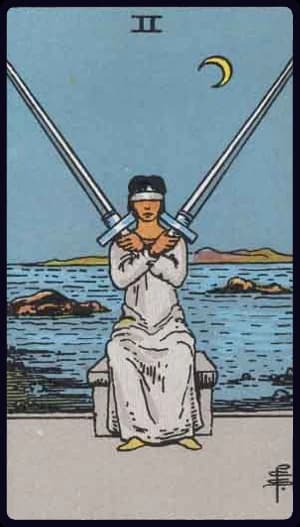
Two of Swords
swords · 2
Keywords: stalemate, blindfolded choice, held balance — reversed: forced decision, peeking, released deadlock.
Two of Swords in the Past position
Upright
You held two options in balance for a long time, and that stalemate quietly did a job for you.
In the past position, the Two of Swords describes a stretch when you declined to decide and called it something else — waiting on more information, respecting someone else's timeline, keeping your options open. What is easy to miss now is that the refusal worked. Holding two things level kept a relationship intact, a job survivable, or a conversation from detonating before you could afford the fallout.
The figure on this card sits blindfolded with two blades crossed at the chest, and the pose rewards a literal reading. Those arms are not resting. The balance is muscular, held by continuous effort, which means the fatigue you may still associate with that period of your life was the price of the holding rather than evidence that you were passive in it.
The correction worth making is about how you have filed those years. If you describe them as time wasted being indecisive, you have deleted the strategy and kept only the embarrassment. This card in the past says the deadlock was chosen, however unconsciously, and someone capable of choosing a stalemate is equally capable of ending one when the terms change.
Reversed
A decision behind you was made by a deadline, a person, or a glance you were not supposed to take.
The Two of Swords reversed in the past points to a deadlock that ended without your consent. A deadline expired, someone else moved first, or circumstances quietly removed one of the two options while you were still weighing them. The result may even have been the one you would have picked, which is precisely why it has never managed to feel finished.
There is a second version, quieter and far more common. You lifted the blindfold early. You already knew which way you were going, and you spent the remaining weeks assembling reasons that would make the outcome look deliberative to whoever was watching. The Two of Swords reversed catches that gap between what you knew and what you performed, and the gap is usually where the discomfort still lives.
Either way the residue has the same shape. Because you never openly claimed the choice, there is no clean record of your having made it, so the question reopens every time something goes wrong downstream. Retroactively owning it — saying plainly that you chose this, even if the timing was forced on you — is the part of the old event that remains available.
Two of Swords in the Present position
Upright
Something is currently held in perfect balance because the deciding fact has not been let into the room.
Right now the Two of Swords describes an active stalemate rather than a stuck one. Two options are being weighed with unusual evenness, and that evenness is worth suspecting. Genuinely equal options are rare; what is far more common is a scale kept level because one specific piece of information has been carefully left off it.
You most likely know what that piece is. It is the conversation you have not initiated, the number you have not actually run, the direct question you have not asked because an answer would end the deliberation and start the consequences. The blindfold in the image is tied on rather than fallen — the not-seeing is being maintained, and today that maintenance is costing you something real.
Behind the seated figure lies dark water and scattered rock, which is exactly the part of the scene the blindfold works to exclude. Nothing here says the balance is wrong to hold. It says the balance is a position you are paying for by the hour, and pricing that honestly against the one uncomfortable hour of simply looking is the current task.
Reversed
The blindfold is slipping right now, and the deliberation has quietly turned into theatre.
The Two of Swords inverted in the present shows a stalemate breaking down while the performance of it continues. You are still asking people for input, still framing the matter as genuinely open, but somewhere in the last few weeks you settled it privately. The consultation happening today is not research. It is a search for someone willing to co-sign.
The other live form is pressure from outside. A deadline, a counterpart's patience, or a bill is about to collapse the Two of Swords on your behalf, and some part of you is relieved, because a forced decision cannot be blamed on your judgement. That relief deserves naming, since it buys short-term comfort at the cost of an outcome you never quite agreed to.
What separates the two situations is procedural rather than emotional. Write down the choice you would submit if you had one hour, seal it, and watch your own reaction. Relief means the matter is already decided and you are managing appearances. Dread means the balance is real and deserves whatever time it has left before circumstances take it.
Two of Swords in the Future position
Upright
Ahead is a hold you can make deliberate, defined by a condition you name in advance.
Forward from here, the Two of Swords points to a stretch where not deciding is the correct move. That is unusual for this suit, which generally rewards cutting, and it is why the card matters in this position: the information that would settle the question has not arrived yet, and moving before it does would only convert a real decision into a guess.
The distinction that will matter is between a hold and a drift. A hold has a name, a reason, and an end condition — a date, an answer owed by someone else, a threshold written down somewhere you will actually see it. A drift has none of those and simply continues, which is how a deliberate pause becomes the thing you are still doing a year from now.
The crescent moon above the figure is the detail to keep in mind for what is coming. Moonlight gives you shape without colour, which is roughly the grade of information available in the months ahead — enough to know something is there, not enough to name it precisely. Deciding now what would count as sufficient light is the actual work of this position.
Reversed
A deadlock ahead breaks on someone else's schedule, and relief arrives well before ownership does.
A reversed Two of Swords in the future usually describes a resolution you do not author. The blades come uncrossed because a role gets filled, an offer expires, or a person stops waiting, and the first feeling is relief, since the weight of holding the balance is finally gone. The complication turns up a week later, when you notice you never agreed to the result.
There is also the version where you break the deadlock yourself, abruptly, mainly to stop feeling it. Decisions made to end discomfort tend to be defended aggressively afterwards, because examining them would reopen the discomfort they were built to close. That pattern is worth watching for in the coming months, especially around anything you have been sitting on for years.
The preparation that helps is unglamorous and small. Before the pressure arrives, write down which of the two options you could live with and what you would want in exchange, so that when the release comes from outside you hold terms rather than only a reaction. An ending imposed by circumstance is far easier to absorb when your conditions were already on the table.
What if this card comes to you?
Pull three cards for your own question — past, present and future. Free, no account needed.