


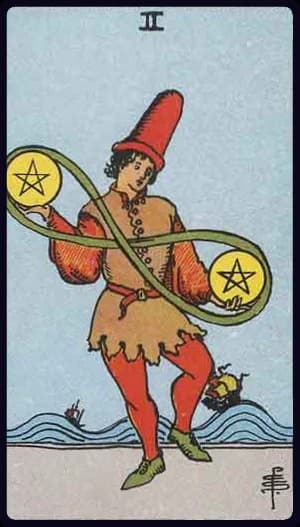
Two of Pentacles
pentacles · 2
Keywords: juggling, adaptable balance, two priorities — reversed: dropped ball, overcommitment, lost rhythm.
Two of Pentacles in the Past position
Upright
You already carried two things at once for a stretch, and the skill you built there is still yours.
In the past position, the Two of Pentacles points at a period when you were running two things in parallel — a job and a course, a household and a side business, one person's needs and another's — and you kept both moving. It rarely felt like competence at the time. It felt like being behind on everything simultaneously, which is exactly what juggling feels like from the inside.
The dancer on the card is not standing still; the coins move because the body moves, traced through a ribbon that has no stopping point. What you learned before now was cadence rather than capacity — when to let one thing sit at the bottom of the arc while you handled the other. That is a real skill, and it was built under load, which is the only place it can be built.
Two ships ride heavy water behind the figure, and they usually get skipped in the reading. They say the conditions back then were genuinely rough, not that you mismanaged calm. If you have been describing that past stretch as chaos you barely survived, you are filing a demonstrated ability under damage, and that misfiling is doing current work for you — badly.
Reversed
Something you were holding got dropped before, and you have been careful with your hands ever since.
Reversed in the past, the Two of Pentacles usually marks a stretch where the count got away from you. Not two things — four, six, with the extras unacknowledged because acknowledging them would have meant declining one. The drop, when it came, was rarely the largest item. It was the quiet one with no deadline attached and therefore no alarm on it.
There is a second version of this that reads almost identically from the outside. The rhythm broke rather than the load, and an arrangement that had been sustainable for months stopped being so without the amount of work changing at all. People search afterwards for the added task that caused it and find nothing, because what failed was the spacing between things and not the things themselves.
The residue is what matters in this position. A dropped ball behind you tends to produce one of two habits: handling a single item at a time with unnecessary rigidity, or over-scheduling as proof that the earlier failure was circumstantial. Working out which habit is yours is more useful than relitigating the original stretch, which is closed and not available for revision.
Two of Pentacles in the Present position
Upright
Right now you are holding two live priorities, and neither one is asking to be abandoned.
In the present position, the Two of Pentacles describes a situation people keep trying to solve when it is meant to be operated. Two commitments are currently in play, and the pressure — internal, usually — is to collapse them into one and be done with the tension. The card declines that framing, and it declines it on the grounds that both are legitimate.
Look at what the figure is actually doing. The weight is on one foot, the knees are bent, the coins sit at different heights inside a single looping ribbon. Nothing there is balanced in the static sense. Balance in this image is a verb, produced continuously and lost the moment the movement stops, which is the whole operating instruction of the card.
The useful question today is not which priority matters more. It is what each one actually requires per week, stated in hours rather than in feeling. Most of the strain in a Two of Pentacles situation comes from carrying an unmeasured load and reading the discomfort as evidence that the arrangement is wrong. Sometimes it only means the arrangement is heavy.
Reversed
Count what you are currently carrying, and include the items you would not list out loud.
The Two of Pentacles inverted in the present is a counting problem before it is anything else. The visible commitments number two or three; the real total includes the ones that never appear on a calendar — someone you are managing emotionally, a decision you postpone daily, a body you are not maintaining. Those draw on the same hours as the listed work does.
Overcommitment rarely announces itself as too much work. It announces itself as small failures of rhythm: replies going out three days late, the same errand deferred five times, a task that used to take an hour now taking a morning because it gets started and abandoned repeatedly. The load has not grown. The spacing between things has collapsed, and output follows spacing.
What this card asks right now is unglamorous. Something is already being dropped, and at present it is being selected by default rather than by you — almost always the item with no external witness attached to it. If one thing has to fall this month, choosing it deliberately is a materially different act from discovering the loss weeks later.
Two of Pentacles in the Future position
Upright
A second demand is coming, and the period ahead will run on cadence rather than on raw effort.
In the future position, the Two of Pentacles describes an arrangement rather than an event. Something gets added — a role, a person, a project carrying its own clock — and the coming stretch has you running two things concurrently for longer than you would choose. The card does not treat that as an emergency. It treats it as a mode of operation with rules.
The number two is doing work here. One thing is a task and three is a system, but two is the count at which trade-offs become visible and unavoidable, because every hour given to one is plainly taken from the other. That visibility is the gift in this position: nothing ahead will be hidden from you, only inconvenient to look at directly.
Preparation that helps is specific and boring. Decide in advance what each commitment gets in a normal week and what it gets in a bad one, since bad weeks are where cadence is actually set. The figure keeps the coins moving by gripping neither of them, and the equivalent going forward is permission to let one thing idle briefly without filing that as neglect.
Reversed
Ahead is a stretch where the rhythm slips first and the visible work keeps looking fine for a while.
A reversed Two of Pentacles in the future position points at a coming period where the arrangement holds on paper and stops holding in practice. The commitments will still be listed, the meetings will still happen, and the quality underneath will thin out quietly. That is why this shape is hard to catch early — nothing dramatic fails, so nothing triggers review.
The likelier trigger is not a crisis but an addition: a third thing accepted during a good week and then inherited by every week after it. Good weeks are poor sampling. Capacity measured at your most rested becomes the standard you hold yourself to when you are not rested, and the resulting gap gets read as a character flaw rather than an arithmetic one.
What can be done now is set the drop order. Write down which commitment gets reduced first, second, and third when the next stretch tightens, and what reduced means concretely for each one. Made ahead of time, that list is planning; made in the moment, it is triage, and triage protects whatever is loudest instead of whatever actually matters to you.
What if this card comes to you?
Pull three cards for your own question — past, present and future. Free, no account needed.