


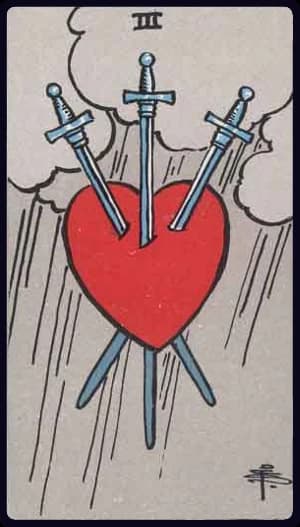
Three of Swords
swords · 3
Keywords: heartache, painful truth, clean cut — reversed: healing, nursed wound, released hurt.
Three of Swords in the Past position
Upright
Something behind you was finally said in plain words, and the plainness of it is what rearranged your life.
In the past position, the Three of Swords marks the moment a piece of information stopped being deniable. Someone said it plainly, or you finally read the evidence you had spent months rearranging into a kinder shape, and the sentence could not be un-heard afterwards. Everything you built from that point was built by a person carrying that sentence.
The image is unusually literal for a tarot card: three blades through a single heart, grey cloud, steady rain. There is no allegory to decode, and that is the point of it. What happened to you was not subtle, and it did not require interpretation at the time. The number three matters here too, because two swords can argue forever and a third one settles the question.
The reading worth taking from this position is that the cut was clean. Painful truth is not the same injury as prolonged confusion, and people routinely mourn the wrong one. Whatever ended before, ended in a way that let you know where you stood, and standing somewhere definite is what made the years after it navigable at all.
Reversed
An old hurt either closed quietly without ceremony, or was kept warm long past its usefulness.
The Three of Swords reversed in the past describes what you did with an injury rather than the injury itself. One version is a wound you nursed. The story got told often enough to become a fixed account, the details hardened, and somewhere in the retelling it stopped being an event that happened to you and became a description of who you are.
The other version is quieter and more common than people expect. The hurt released on its own while you were busy, and nobody marked the date. You went back to check the sore spot at some point and found it had gone flat. Because there was no ceremony, you have carried on behaving as though it were still tender, which costs something.
The Three of Swords inverted behind you is mostly about which account you are still running. In the image the blades stay in the heart, and reversal is often read as the point where they loosen and fall out. Whether that already happened is a question of evidence rather than feeling, and the evidence is in how you talk about it now.
Three of Swords in the Present position
Upright
There is a sentence currently in the room that everyone has agreed to walk around instead of saying.
Right now the Three of Swords is pointing at something known and unspoken. It is not a secret exactly, since more than one person can see it. It is a fact being managed by tone and scheduling, and the effort of managing it has quietly become a larger daily expense than the fact itself would be if stated.
The suit is swords, which in the tradition means language and the mind, and this card is the moment language does its cutting work. Saying the true thing hurts on contact and stops hurting in the specific way that unnamed things do not. What you are currently protecting is not the other person's feelings so much as the arrangement that lets the topic stay unaddressed.
The practical read today is to separate the pain of hearing from the pain of hovering. One has an end and the other renews itself every morning. If you are choosing the second because it feels gentler, notice that you have been choosing it repeatedly, and that a decision made daily is a decision made, whatever it is called.
Reversed
You are somewhere between rehearsing an injury and actually repairing it, and the two look alike from inside.
Reversed in the present, this card sits over an active wound and asks what is being done with it. Recovery and rehearsal produce very similar behaviour. Both involve returning to the incident, both involve talking it through, and only one of them changes the account each time. Repetition without revision is the tell, and it is visible to you before it is visible to anyone else.
There is a second possibility worth weighing honestly, which is that the healing is real and simply undramatic. The Three of Swords reversed frequently marks the unglamorous middle of recovery, where nothing feels resolved because resolution is not an event. The blades come out slowly, and slow is not the same as stalled.
What separates the two states is whether the hurt is currently costing you anything new. A wound being nursed keeps taking withdrawals — from attention, from other relationships, from the version of you that would otherwise be busy elsewhere. A wound closing takes less each week. Checking the trend is more useful than checking today's intensity.
Three of Swords in the Future position
Upright
Ahead of you is a piece of clarity that hurts on arrival and simplifies everything after it.
In the future position, the Three of Swords describes information rather than misfortune. Something becomes clear that you have been half-suspecting, and the clarity arrives at cost. The card does not say the situation is unsalvageable; it says that whatever comes next will be built on an accurate picture instead of a comfortable one.
The value of knowing this in advance is that it changes what you prepare. Most people brace for the emotional impact, which arrives regardless and passes on its own schedule. The part that actually benefits from preparation is the decision that follows, because a fact of this kind usually removes an option you had been quietly relying on.
It helps to remember that the three blades in the image are not still falling. They have landed, and the rain in the background is already thinning at the edges. What is coming is the end of a question rather than the beginning of an ordeal, and the difference will be obvious in retrospect and hard to feel at the time.
Reversed
What opens next is release, though it will arrive without the apology you were holding out for.
Looking forward, the Three of Swords reversed points at a hurt that stops occupying the centre of things. It will not resolve the way you have imagined it resolving. There will probably be no acknowledgment from whoever caused it and no scene in which the record gets corrected, and the release happens anyway, on unrelated grounds.
This tends to feel like a loss of its own, which surprises people. A long-carried injury organises a lot around itself, and when it loosens there is a gap where the organising used to be. Some of what you have been calling grief in recent months is closer to the discomfort of that vacancy, and it eases once something else fills it.
The one thing worth watching for in the months ahead is the reflex to re-open the wound when a new situation resembles the old one. The card's reversed sense includes hurt that gets recycled rather than retired. Naming the resemblance out loud, early, is usually enough to keep the coming version from inheriting the last one's blades.
What if this card comes to you?
Pull three cards for your own question — past, present and future. Free, no account needed.