


Three of Pentacles
pentacles · 3
Keywords: craft, collaboration, recognised skill — reversed: mismatched team, unclear role, sloppy work.
Three of Pentacles in the Past position
Upright
Skill you treat as ordinary was already built by years of repetition nobody applauded.
In the past position, the Three of Pentacles marks a stretch of work that was tedious while you were inside it — the third version of the same document, the shift nobody wanted, the small repair done properly when a rough one would have passed inspection. None of it felt like formation at the time. It was.
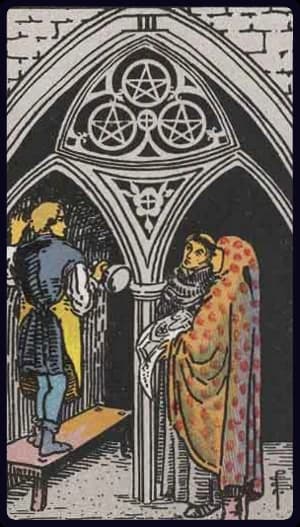
The card shows a mason at work on a cathedral that will not be finished in his lifetime, watched by two figures holding the plans. What the image records is the moment craft stopped being private: someone put your hands on the real building rather than a practice piece, and the standard stopped being your own opinion of your work.
Reading this position accurately means separating two things you have probably merged. The praise you received before was inconsistent and usually went to whoever explained the work best. The skill accrued anyway, in your hands, independent of who noticed. Recognition and competence arrived on different schedules, and only one of them is still yours to draw on.
Reversed
Behind you sits a project where nobody named who owned what, and you are still adjusting for it.
The Three of Pentacles reversed in the past usually describes a collaboration that failed at its definitions rather than at its effort. Roles overlapped or vanished; two people polished the same section while a third was never assigned; the work shipped late, and the account of why it went late never matched what actually happened in the room.
There is a second version, less comfortable to sit with. Sometimes the sloppy work behind you was yours — delivered to a standard you knew was under your own, on a deadline you had accepted without checking what it required. The Three of Pentacles inverted does not moralise about this, but it does insist you know which version you are carrying.
Either shape leaves a working habit. People who came out of an undefined team tend to over-specify everything afterwards, or to refuse shared work entirely and call it efficiency. The original project is finished and unavailable for correction. The reflex it installed is neither of those things, and that is the part worth naming.
Three of Pentacles in the Present position
Upright
Your work is currently being looked at by people whose judgement actually costs you something.
Something you are making is no longer being assessed by you alone. There is a review, a client, a collaborator, a room where the thing gets discussed with you sitting in it. That exposure is uncomfortable in a specific way, and it is also the only mechanism by which craft improves faster than solitary practice allows.
The scene on the Three of Pentacles is a working site, not a ceremony. The mason stands on a bench, the plans are in someone else's hands, and the three carved discs sit above them all in an arch that is still unfinished. Right now you are somewhere in that arrangement: doing the work, holding the drawing, or arguing about the gap between them.
The practical question today is whether you are treating feedback as verdict or as material. Verdict-mode makes every comment about your worth and produces defensiveness dressed up as expertise. Material-mode asks what the objection reveals about the object itself. The same conversation goes two entirely different ways depending on which one you choose before walking in.
Reversed
Right now the job has no agreed edge, so effort is going where it will never be counted.
The inverted Three of Pentacles describes unclear ownership far more often than it describes laziness. You are currently doing part of someone else's task, or two of you are quietly doing the same one, and nobody has said the sentence that would resolve it because saying it out loud feels like a complaint.
It also covers over-craft, which is easier to defend and harder to notice. Time goes into the section you find satisfying while the part that determines whether the whole thing stands stays untouched. This is not sloppiness in the ordinary sense; it is precision aimed at the wrong surface, and it produces the same result as carelessness.
The test that separates these is quick and slightly awkward: write down what finished looks like for this piece of work, then find out whether the other people involved would write the same sentence. If nobody can produce it today, the problem is not effort, and adding more effort will make the mismatch more expensive rather than less.
Three of Pentacles in the Future position
Upright
Ahead is a room where your work is named as yours and used by people who can build on it.
Skill becoming visible is what the Three of Pentacles points to from this position — an invitation to contribute as the person who knows how, rather than as the person who happened to be available. It tends to arrive as a specific request: join this, fix this, build this part. It arrives because of work already done, not because of how you described yourself.
What the card offers is narrower and more useful than success. It says the coming stage is collaborative: the thing you make next will be assembled with other people's constraints inside it, and your name will be attached to a shared object rather than a private one. That changes what counts as a good outcome.
The preparation that matters is deciding in advance how you will respond when your part gets altered by someone else. Recognition brings that with it. The cathedral is not yours alone, the plans are held by people who will not automatically defer to you, and craft that cannot survive negotiation tends to stall at exactly the point where it was about to be seen.
Reversed
A collaboration coming toward you will stay vague unless someone insists on defining it early.
Terms that never get settled are the risk this card marks when it falls inverted here. The enthusiasm at the start will be genuine, the division of labour will be assumed rather than stated, and the mismatch will surface at the point where it is most expensive to repair — near delivery, in front of whoever has been waiting.
A quieter version involves standards rather than roles. With nobody checking the work, a threshold drifts downward in increments too small to register, and the Three of Pentacles inverted marks the moment that drift becomes visible to someone outside. Work done alone for long enough loses its calibration rather than its effort.
Neither shape asks you to avoid what is coming. Both ask for an unglamorous conversation at the beginning, while goodwill is high and the question still sounds procedural: who decides, who does which part, and what counts as done. Raised later, it reads as an accusation. Raised now, before anything has gone wrong, it reads as competence.
What if this card comes to you?
Pull three cards for your own question — past, present and future. Free, no account needed.