


The World
Major Arcana · XXI
Keywords: completion, wholeness, full circle — reversed: almost there, loose ends, delayed closure.
The World in the Past position
Upright
You already finished something whole, and the reason it stopped feeling like an achievement is that nobody marked it.
The World in the past position usually marks a cycle you carried all the way to its end — a degree completed, a relationship taken to its real conclusion rather than its convenient one, a job you left having done the dull last stretch as well as the interesting middle. The completion itself is not in doubt. Your record of it is, and that is a different problem with a different fix.
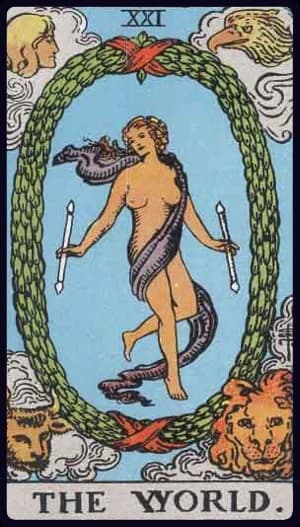
This is card twenty-one, the last of the major sequence, and it earns that place by arriving after everything else rather than instead of it. The wreath in the image is a closed oval, and closed is the working word: the shape exists only because the line came back around to meet itself. Whatever was walked before the return is part of the shape too, including the stretches nobody watched.
The practical read here concerns what you did before and what that says about what you can do. People who finish things tend to file their finished things under circumstance — good timing, a supportive manager, an unusually light year. If that is how the past is stored, you have quietly removed completion from your list of abilities, and it belongs on that list ahead of most of the things currently on it.
Reversed
Behind you sits something finished to ninety percent, and it is still quietly billing you.
There is usually a specific object attached to this card in the past position: a manuscript never formatted, an apology drafted and never sent, a project handed over two steps before the handover was actually real. Nothing dramatic happened to any of them. Attention simply stopped arriving at the point where the work turned administrative, and the thing has been sitting there in that state ever since.
The second version is stranger and more common than people admit. The work did finish, fully and on time, but nobody marked it — no ceremony, no last conversation, no line drawn anywhere visible. The World reversed in this position describes closure that occurred on paper and never registered anywhere else, which is why an event settled years ago can still be argued about internally at two in the morning.
Either shape explains a habit you are running today. Someone carrying an unclosed loop behind them either avoids starting things they can already sense they would abandon near the end, or finishes everything compulsively and takes no pleasure in any of it. Whether the original item is still worth completing is an open question; the reflex it installed is the part actually available to you now.
The World in the Present position
Upright
Something in your life is complete right now, and the odd part is how little relief arrived with it.
Right now the tell is not celebration but flatness. The World in the present position describes a chapter that has genuinely closed — the role has stopped teaching you anything, the questions it used to raise have all been answered, and maintaining it costs attention while returning none. That is what a finished thing feels like from the inside, and it is routinely misfiled as burnout or ingratitude.
The figure in the image dances inside the wreath holding a baton in each hand, with four creatures fixed at the corners of the card. The corners are the part worth noticing: wholeness in this card means nothing is left outstanding at the edges, not that everything in the frame is pleasant. And the figure is still moving. Completion here is a position you occupy, not a chair you get to sit down in.
The useful move today is saying out loud that the finished thing is finished, which is harder than it sounds because the sentence dismantles a structure that has been organising your weeks. Most people postpone it and let the situation decay instead, which produces the same ending some months later with more damage attached and none of the credit that was available for calling it early.
Reversed
Count what you are carrying at ninety percent today; the number is usually higher than you expect.
Two different situations sit under this card in the present, and both feel from the inside like being busy. In the first, several things are parked at ninety percent right now, and the last tenth of each is administrative — the formatting, the invoice, the follow-up email. Every one of them is defensible on its own, and together they consume exactly the attention you would need to begin anything new.
In the second, something is over and you keep reopening it. The World reversed describes a loop held deliberately ajar, because the closed version would take an identity out with it: the person who held that job, that relationship, that long-running argument. Reopening reads as conscientiousness from the outside and functions as postponement from the inside, and the difference is invisible to observers.
The test that separates them is unglamorous. Write down what remains on each unfinished item, as specific tasks with times attached. If the whole list resolves into a few hours, capacity is not the constraint and the resistance is about ending rather than working. If the list refuses to resolve into tasks at all, you are in the second situation, where no amount of effort closes anything because effort was never the missing piece.
The World in the Future position
Upright
An ending that counts is coming, and the harder part is the empty room on the far side of it.
What arrives ahead is a completion you can name — a project signed off, a debt cleared, a course of study or treatment or renovation reaching its actual last day. The World in this position makes no claim that the outcome is a good one, only that the circuit closes. Something you have been carrying for a long stretch stops being carried, and the date is usually nearer than your planning assumes.
The part worth preparing for is what a completion removes. Any long undertaking supplies structure: deadlines, a reason to decline invitations, a ready answer to the question of what you are doing with yourself. When it closes, all of that leaves with it, and the flat week that follows catches people off guard because they budgeted for the finish and never for the day after the finish.
So the work now is deciding what the next circuit is, or deciding on purpose to leave the space empty for a defined stretch of time. Both are real choices; drifting into whatever fills the gap first is not one. This card sits at twenty-one and the deck returns to zero immediately after it, which is the tradition's blunt way of saying that an ending is a position on a circle rather than a destination.
Reversed
The closing ahead of you either arrives later than promised or gets announced before it is done.
The common shape here is drift in the date rather than failure of the thing. A sign-off, a final payment, a last conversation, a set of keys returned — the ending exists and keeps moving by a week at a time, usually for reasons that belong to other people. Nothing collapses, which is precisely why it can continue for months without anyone involved treating it as a problem worth naming.
The other shape is a completion declared early. The announcement goes out, the celebration happens, and a tail of loose ends stays behind to resurface three months later as somebody else's urgent request. The World reversed in the future position is describing the gap between the feeling of being finished and the state of being finished, and the feeling is available considerably sooner than the state.
The preparation that helps is written and boring. Decide now, while nothing is at stake, what specifically counts as done — which document, which transfer, which sentence said to which person — and treat everything short of that as in progress regardless of how it gets described in the room. Ambiguous endings are harder to act on than clean ones, and most of the ambiguity is removable in advance.
What if this card comes to you?
Pull three cards for your own question — past, present and future. Free, no account needed.