


The Tower
Major Arcana · XVI
Keywords: sudden collapse, revelation, cleared ground — reversed: averted crisis, slow crumble, fear of the fall.
The Tower in the Past position
Upright
Something in your past came apart without warning, and you are still building on the cleared ground.
In the past position, The Tower marks a specific rupture behind you — a job that ended abruptly, a relationship that broke in one conversation, a belief about yourself that stopped being available. The card is not asking you to revisit the pain. It is pointing out that the ground you currently stand on was cleared by that event, which means some of what you call your own choices were actually made for you.
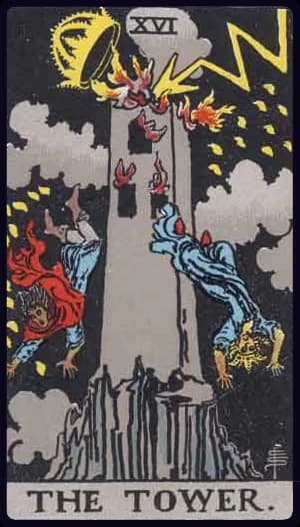
The RWS image shows the crown still on the tower as it falls. Read backwards, that detail matters: the structure was legitimate before it went. People who draw this card in the past position often carry a quiet embarrassment about the collapse, as though they should have seen it coming. Traditional readings are consistent that the lightning is external. Hindsight manufactures warning signs that were not legible at the time.
The practical read is about inheritance. Whatever you built after that rupture was built fast, under pressure, with the materials available. Some of it is excellent and some of it was only ever meant to be temporary. This position invites you to sort which is which, now that you are no longer in an emergency.
Reversed
A collapse you braced for in the past never actually arrived, and part of you never unclenched.
Inverted in the past position, this card usually describes a near miss. The layoff that skipped you, the diagnosis that came back clear, the argument that could have ended things and did not. Objectively nothing broke. But the body registered the approach, and bracing leaves marks that events do not.
The other common form is a slow dismantling rather than a strike — something in your history that eroded over years while everyone involved described it as fine. There was no moment to point at, which is precisely why it is hard to grieve. Endings without a date do not get processed; they get absorbed.
Either way, this position is describing why you are more prepared than the situation requires. Vigilance that was once accurate has outlived the conditions that produced it, and it is easy to mistake that leftover readiness for good judgement. The Tower reversed behind you is not a prediction about anything; it is an explanation for a habit. Knowing which of your instincts belong to a building that never actually fell is worth more than the instincts themselves.
The Tower in the Present position
Upright
A structure you are actively maintaining is not holding, and the effort of holding it is now the main problem.
In the present position, The Tower is unusually literal. Something in your life right now requires continuous effort to stay standing, and that requirement has become invisible to you because it is daily. The card does not predict the fall; it identifies the propping. Most people who draw this already know which arrangement is meant — they have simply been filing it under commitment rather than strain.
The two figures falling from the tower are often read as loss of control. A more useful reading in the present tense is loss of position: they are no longer above anything. Status inside a failing structure is the last thing to go and the hardest to release, which is why people stay in situations they can clearly describe as unworkable.
What this position asks is narrower than it looks. Not whether to leave, not whether to rebuild — only whether the maintenance you are performing is repair or postponement. Those feel identical from inside and diverge completely in cost.
Reversed
You are managing a collapse in slow motion, and the patching is costing more than the break would.
Reversed in the present, this card describes active containment. Small failures are being absorbed one at a time so the whole thing does not go at once — a budget covered from savings each month, a role quietly expanded to cover someone else's gap, a relationship where the same conversation is had and shelved on a cycle. Nothing has broken. Everything is being held.
The cost of this arrangement is paid in attention rather than money, which makes it easy to underreport. Traditional caution here is against reading postponement as stability. A crack that reopens on schedule is not being fixed; it is being visited.
There is a second, gentler version worth ruling out first: anticipating collapse in something structurally sound, usually because a previous structure did fall. That fear is accurate information about your history and unreliable information about your present. When The Tower appears reversed in this position, the distinguishing question is simply whether anyone outside your own head shares the concern.
The Tower in the Future position
Upright
A clearing is coming that you will not choose, and what survives it will be what was actually load-bearing.
In the future position, The Tower reads less like a warning and more like a schedule. Something ahead resolves by breaking rather than by negotiation. The card carries no moral weight about this — the lightning is not punishment, and the structure is not being judged. It simply reaches the end of what it can hold.
Readers often soften this position into vague caution, which wastes it. The specific value of The Tower in the future is that it tells you the mode of the ending, not its timing. Endings by collapse do not respond to preparation the way endings by decision do. You cannot negotiate with them; you can only decide in advance what you would want to carry out.
That is the actionable read. Not bracing, not preventing — inventorying. If an arrangement in your life came apart on short notice, what would you want already backed up, already said, already held somewhere other than inside that arrangement? Answering that costs little and is useful whether or not the card is right.
Reversed
Ahead is either a fall you talk yourself out of, or one you keep deferring until the deferring becomes the story.
A reversed Tower in the future position describes an ending that does not resolve cleanly. The likeliest shape is deferral: a decision that stays available for much longer than it stays useful, revisited quarterly, never taken. Nothing dramatic happens. The situation simply keeps its options open on your behalf until the options close by themselves.
The second shape is a crisis averted at the last moment, followed by an unexpectedly difficult period. People assume relief follows a near miss. Often what follows is disorientation, because the energy assembled for a rupture has nowhere to go and turns inward as restlessness or second-guessing.
Both shapes share one feature: the outcome is more ambiguous than the card's reputation suggests. Ambiguity is harder to act on than collapse, so the useful preparation is different. Decide now what evidence would tell you the deferral has become permanent — a date, a number, a repeated conversation — so the decision does not depend on how you feel in the moment you finally face it.
What if this card comes to you?
Pull three cards for your own question — past, present and future. Free, no account needed.