


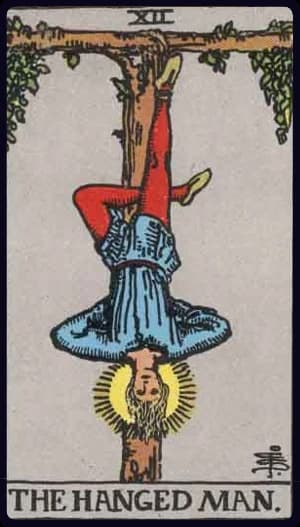
The Hanged Man
Major Arcana · XII
Keywords: suspension, reframing, willing pause — reversed: stalling, martyrdom, wasted waiting.
The Hanged Man in the Past position
Upright
A stretch of enforced stillness behind you rearranged what you actually wanted.
Behind you sits a season when things stopped moving and the timing was not yours to set — an illness, a stalled project, a year spent waiting on somebody else's signature. The Hanged Man treats that period as an event rather than a blank space, and what belongs in the record is not the length of the delay but the shift in reading that happened while you were held there.
The image is specific about the mechanics. The figure hangs by one ankle from a living beam, hands hidden behind the back, the free leg crossed into a figure four, and the halo appears only in that inverted position. Numbered twelve, the card sits after the ledger of Justice and before any ending, which is tradition's way of saying the suspension came with its own instruction rather than a punishment.
The honest read here is about attribution. If you remember that period only as time lost, you are quietly disowning a conclusion you reached inside it — about a person, a job, a version of ambition that stopped fitting. You did not think your way there on a good day at a desk. You got there because you could not move, and the view from that angle was already different before the situation released you.
Reversed
Waiting you once called patience had stopped producing anything long before it ended.
The Hanged Man reversed in the past describes a pause that outlived its purpose. There was a point when the waiting was genuinely doing something — letting a situation clarify, letting a person show you their pattern — and a later point when it was only habit wearing a reasonable explanation. The gap between those two points is where the card is pointing, and it is usually longer than anyone wants to admit.
The second shape is heavier. The Hanged Man reversed also covers the sacrifice you made and never named out loud: a position you held, a cost you absorbed, a household or a team you carried on the understanding that the arrangement was temporary. Nobody was told the terms, so nobody could accept or decline them, and the invoice went unsent while it kept accruing interest.
What matters is that this already happened and is not open for renegotiation. What remains open is the reflex it installed. People who waited too long once tend to overcorrect into refusing all stillness, or to repeat the arrangement with new characters because the shape feels like loyalty. Naming which of the two is yours is more useful than relitigating the years themselves.
The Hanged Man in the Present position
Upright
Nothing is moving right now, and what the situation asks for is a change of angle rather than effort.
In the present position, The Hanged Man tends to find somebody applying force to a situation that does not answer to force. A decision sits with another person, a process runs on its own clock, a relationship needs time that cannot be compressed by wanting it compressed. The energy currently going into pushing is producing fatigue rather than motion, and the fatigue is being misread as evidence of effort.
The expression on the suspended figure is the detail worth borrowing today. He is not fighting the rope. The crossed leg makes a shape closer to composure than to captivity, and the card's element is water, which never argues with the container it is poured into and still ends up everywhere it needs to be. Suspension here is a posture that was chosen, not a sentence that was handed down.
The practical version of this is unglamorous. Write out the situation as the other party would describe it, in their vocabulary, without correcting them. Most people cannot finish that page, and finding out where it breaks is the reframe the card is offering now. The pause is not empty time to be endured until the real work resumes; it is the only window where your reading of the thing can actually change.
Reversed
Something you are currently calling a pause is functioning more like a hiding place.
The Hanged Man inverted right now describes two situations that feel identical from the inside. In the first, a genuine pause has quietly become a residence. The language stayed the same — taking stock, waiting for clarity, not rushing it — while the content emptied out, and no single week looks like avoidance even though the year does.
In the second, the stillness is being performed for an audience. The Hanged Man reversed covers visible sacrifice: staying late where it will be noticed, absorbing a burden while making sure the weight registers, waiting in a way designed to be witnessed. This is not the same as generosity, and the difference shows up in how it feels when nobody comments.
One test separates them right now. Say what condition would end the waiting, in a sentence with a date or an event in it. If the sentence does not exist, you are in the first situation and the remedy is a deadline you set yourself. If the sentence exists but you notice you would be disappointed to lose the position, the waiting is buying you something other than the outcome you have been describing.
The Hanged Man in the Future position
Upright
Ahead is a delay that ends up doing more for you than the outcome you were chasing.
What opens up ahead is an interruption rather than a defeat. Something gets postponed, held up, or handed to a slower authority than you had planned around, and the first reaction will be to treat the gap as damage. The Hanged Man makes a narrower and more useful claim: the interval has content, and the content is a correction to how you have been framing the whole question.
This is the card of the willing pause, and willing is the operative word for what is ahead. The suspension arrives either way; what remains yours is whether you spend it fighting the rope or looking around from the new angle. The figure in the image is upside down and calm, and the tree he hangs from is alive and in leaf — the arrangement is temporary and it is not barren.
Because the shape of this is knowable in advance, it can be prepared for. Decide now what you would examine if the thing you are pushing toward went quiet for a season: which assumption you would test, which conversation you would finally have, which number you would look at properly. Deciding it in the moment tends to lose to the urge to fill the time with motion that changes nothing.
Reversed
A wait is coming that will be easy to spend badly and easier to justify afterwards.
A reversed Hanged Man in the future position most often describes time that goes by without being used. Something ahead stalls, and the stalling gets narrated as strategy — the market is wrong, the person is not ready, the moment has not arrived. Each account will be defensible on its own, which is exactly why the months pass without anyone in the story noticing what is happening.
The other form is a sacrifice offered forward on credit. The Hanged Man reversed points at an arrangement you may be about to enter where you carry more than your share on the unspoken assumption that it will be recognised later. Unspoken terms cannot be honoured, because the other party is operating inside a version of the agreement where no debt was ever created.
Neither shape announces itself, which makes them harder to act on than a clean refusal would be. The preparation that works is written and boring: name in advance what you expect in return for what you are prepared to give, and set a date by which a waiting period gets reviewed rather than extended. A stated condition survives the week you feel too tired to argue for it.
What if this card comes to you?
Pull three cards for your own question — past, present and future. Free, no account needed.