


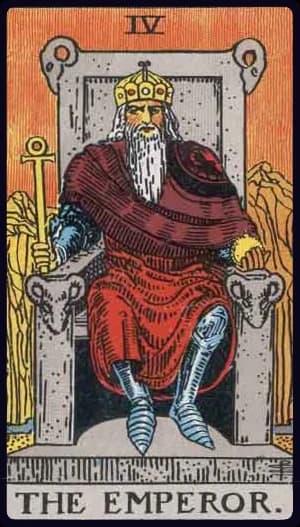
The Emperor
Major Arcana · IV
Keywords: structure, authority, boundaries — reversed: rigidity, control, absent leadership.
The Emperor in the Past position
Upright
Behind you is a structure you built under pressure, and it is the reason the ground holds now.
Somewhere in the past you drew a line and enforced it — a schedule you kept when nobody was checking, a rule about money, a boundary with a family member that cost you the relationship for a season. The Emperor in this position says that decision is load-bearing. Much of the stability you now take for granted rests on a piece of structure you no longer remember installing.
The card is numbered four, the number of the square and of the four corners a foundation needs, and it shows a man seated on stone rather than standing on a battlefield. That detail matters here. What you did before was not conquest, it was construction, and construction is unglamorous work that leaves almost no story worth telling afterwards, which is exactly why people underrate their own.
The practical read is about inheritance from your earlier self. If a system you set up years ago is still running, you are living on borrowed discipline, and borrowed discipline eventually needs renewing. Worth separating which of those old structures still fit the size of your current life from the ones you have simply never audited since the day you put them in.
Reversed
An authority in your history was either too heavy or not there at all, and you still answer to it.
The Emperor reversed in the past position usually describes the shape of the authority you formed under. One version was too present: rules with no explanation, correction without warmth, a household or an early job where compliance was safer than honesty. What you learned was how to survive inside someone else's system, which is a completely different skill from building your own.
The other version is absence. A parent, a manager, a founder who was nominally in charge and functionally elsewhere, so nobody set the terms and you set them yourself far earlier than anyone should have to. That produces competence that arrived before it was wanted, along with a durable suspicion that if you ever stop holding things upright, nothing else will step in.
Both histories tend to arrive at the same habit: an uneasy relationship with your own authority. You either over-apply structure to feel safe or refuse it on principle and call the refusal freedom. This card behind you is not asking you to forgive anybody. It is asking you to sort which of the rules you live by are actually yours and which were installed by someone else.
The Emperor in the Present position
Upright
Right now the missing piece is not effort or talent — it is a line you have not yet said out loud.
Currently there is a situation running on goodwill that should be running on terms. A working arrangement with no defined scope, a friendship where you absorb all the scheduling, a project where everyone is agreeable and nothing is decided. The Emperor upright in the present says the repair is structural rather than emotional, which sounds colder than it is and works considerably faster.
Look at the image again. He sits armoured beneath the robe, on a cube of stone, in a landscape with almost nothing growing in it. Those barren mountains get read as coldness when they are really a statement about cost: structure is what makes a hard environment survivable. Nobody builds the frame because conditions are pleasant. The frame exists precisely because they are not.
The uncomfortable part today is that a boundary does not exist until someone else has heard it and been mildly displeased about it. Before that it is only a preference you are quietly resenting people for failing to guess. Naming the terms now costs one awkward conversation. Leaving them unnamed costs the same conversation later, with interest, plus the version of you who has been keeping score.
Reversed
There is something you are gripping tightly today and calling responsibility rather than fear.
Two different problems wear this card in the present and from the inside they are easy to confuse. The first is control standing in for leadership: work rechecked that needed no rechecking, other people's sentences rewritten, decisions held for a fortnight that could have been handed off on day one. The Emperor reversed names that rigidity, because the grip has stopped tracking any real risk.
The second is the opposite. The throne in some part of your life is empty right now — nobody is deciding, not you and not the person nominally responsible — and the group has settled into a polite stalemate where everyone waits for someone to say the plain thing. Vacuums are rarely dramatic. They show up as meetings that repeat themselves and timelines that slip with no one at fault.
One practical way to tell them apart is to notice what happens if you step back for three days. If things degrade immediately, you have built dependence rather than structure. If nothing moves at all, you are standing inside the vacuum and your reluctance to take the chair is part of why it stays empty. Release fixes the first, claiming fixes the second, and neither works on the other.
The Emperor in the Future position
Upright
Ahead is a role that comes with a chair, and the chair is heavier than the title makes it sound.
Coming into view is a situation where you are the one setting terms — a team, a household decision, a body of work where nobody more senior is going to arrive and rule on it. The Emperor in the future position describes responsibility rather than reward, which is why it often lands feeling less like a promotion and more like something being set down on your side of the table.
What makes it workable is preparation of a specific kind, and it is not more skill. It is clarity about what you will and will not put your name to. The figure holds an ankh in one hand and an orb in the other: authority paired with the thing that authority is supposed to serve. A rule with no purpose behind it turns into an obstacle the moment conditions change.
The useful move before any of it arrives is to name your genuine non-negotiables — three of them, not thirty. Everything outside that short list can flex without costing you anything real, and the flex buys goodwill you are going to want later. People who settle their limits in advance spend far less energy defending them when the pressure is actually on.
Reversed
What is coming will test whether your structure can bend, and rigidity fails long before pressure does.
A reversed Emperor further along usually describes a system of yours meeting conditions it was never designed for. The plan was sound, the rule was reasonable when it was written, and the ground underneath has shifted since. The failure will not look like collapse. It looks like holding a standard that no longer produces the outcome it was originally built to protect.
The second shape is a gap in leadership that opens up ahead of you: someone steps back, a structure quietly dissolves, an agreement expires and nobody moves to renew it. What follows is not chaos so much as slow ambiguity, where responsibility diffuses until it belongs to nobody and the work reverts by default to whoever is least willing to watch it fail.
Preparing for either comes down to the same unfashionable exercise — deciding in advance what you would be willing to give up. Which of your rules are structural and which are merely habit, which pieces of authority you could hand over without resentment. Sorting that while nothing is urgent is dramatically cheaper than sorting it in the middle of something going sideways.
What if this card comes to you?
Pull three cards for your own question — past, present and future. Free, no account needed.