


The Chariot
Major Arcana · VII
Keywords: momentum, discipline, victory by will — reversed: spinning wheels, forced pace, lost reins.
The Chariot in the Past position
Upright
Something behind you was won by holding one direction long after it stopped feeling good.
In the past position, The Chariot marks a stretch when you kept a heading well past the point of comfort — a degree finished, a move completed, a project carried through a year in which nobody was watching closely. The result arrived, and the effort underneath it quietly stopped being visible, including to you.
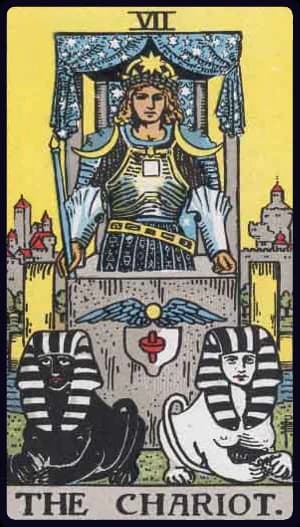
The card is numbered seven and shows a driver standing in a stone chariot drawn by two sphinxes that face slightly apart. There are no reins anywhere in the image. Whatever you finished before now was steered the same way: not by controlling the parts of you that pulled against each other, but by declining to let either one choose the route.
What this position actually asks is whether you kept the skill or only the memory. Discipline that produced a result once tends to get filed away as a phase — something that belonged to a particular job, a particular city, a particular year of your life. It was a capacity, and capacities do not expire when the circumstances that revealed them do.
Reversed
A push already behind you either went nowhere or cost more than it ever returned.
Reversed in the past, The Chariot describes effort that failed to convert. You worked hard across a period that is now closed, and the hours were entirely real, but the direction kept shifting underneath them — a role redefined twice, a plan three people were steering at once, a target that moved every quarter. Motion happened. Distance did not.
The other form is a pace you set for yourself and could not hold. Something got delivered on a schedule borrowed from someone else's expectation, and the recovery afterwards took longer than the work had. The chariot in the image is built from stone for a reason: it is meant to be driven, not carried, and the difference between those two is usually only obvious afterwards.
The residue shows up as an unreliable throttle. People who lost the reins once tend either to grip far harder than a situation requires or to refuse committing to any pace at all, and from the outside both read as prudence. Working out which version the past installed in you is more useful than relitigating the period that installed it, since only one of those is still available to change.
The Chariot in the Present position
Upright
You already have the force you need right now; what is unsettled is where it points.
Momentum is not your missing piece right now. Something is already in motion — a job, a training, a build, a relationship — and The Chariot in the present position rarely turns up to tell you to want it more. What is currently unresolved is whether every part of you is facing the same way while that thing moves.
The two sphinxes are drawn one dark and one pale, harnessed to a single axle, pulling at slightly different angles. Read them as two true things you want that do not agree: security and risk, visibility and privacy, speed and craft. The driver never resolves the disagreement. He holds a heading regardless, and the pair follows because the heading is more definite than either of them is.
So the useful question today is not how to generate more drive. It is which of your competing wants you are willing to leave unsatisfied for the length of this particular stretch. Naming that costs something, because it makes a real loss explicit. Momentum without a named heading simply spends itself on whichever pull happens to be loudest that week.
Reversed
Effort is going in at full volume and your position on the map has not moved in weeks.
The Chariot inverted in the present describes exhaustion without displacement. You are currently busy in a way that is easy to document — messages answered, hours logged, tasks closed — and hard to convert into one sentence about where the thing actually stands. Activity has become the evidence, which is exactly what makes the stall difficult to see from inside it.
One common cause is that the reins belong to somebody else. A client's deadline, a family expectation, a platform's schedule, or a promise you made two years ago is setting the pace, and you are supplying the force for a route you did not choose. The vehicle still moves under that arrangement. It simply arrives somewhere you would not have picked.
The other cause is internal, and quieter: two of your own commitments are pulling at once and cancelling each other out. A blunt test for right now is to describe the last two weeks in terms of distance rather than effort — name what is measurably closer than it was. If the only honest answer is that you are more tired, the problem is steering rather than stamina.
The Chariot in the Future position
Upright
Ahead is a stretch where holding one line matters more than any single decision inside it.
What opens ahead is a period rather than a single event. The Chariot in the future position describes a run that rewards continuity — the same direction held across weeks or seasons — far more than it rewards brilliance at any one moment. That is a different demand from a choice, and it is easy to under-prepare for, because nothing about it feels dramatic while it is happening.
The armour and the star-covered canopy are worth reading together rather than separately. The canopy says the heading is set by something steadier than the daily weather; the armour says you will still be absorbing hits at ground level the whole way. Both are true of the coming stretch, and most people prepare thoroughly for one of them and are surprised by the other.
The practical work is to fix the heading now, while it is cheap, and to decide in advance what would legitimately justify changing it. Momentum will carry you forward past several forks without pausing to ask, and the version of you inside the effort will be a poorer judge than the one reading this today, for the ordinary reason that it will be tired.
Reversed
A push is coming that could arrive on time and still cost more than the arrival is worth.
Inverted in the future position, The Chariot has less to do with failing to arrive than with what the arrival takes out of you. The likeliest shape ahead is a pace set from outside — a launch date, a visa clock, a competitor, someone else's timeline — accepted whole, without renegotiating any of the terms attached to it. The date gets met. The two months afterwards quietly pay for it.
The second shape is a wheel spinning in place. Something with momentum now keeps that momentum well after its reason has expired: a course you no longer need, a plan built for a version of you that has moved on, a role you outgrew some time ago. Nothing forces a stop, so the motion continues on inertia alone, and the cost stays invisible until you compare where you are with where you meant to be.
Both shapes call for the same unglamorous preparation. Decide beforehand what a sustainable pace is for you in actual units — hours, money, weeks of recovery — and what would count as grounds for changing course rather than pushing harder. A threshold written down before the pressure arrives tends to hold. One improvised in the middle of it tends not to, and next time the improvisation will sound just as reasonable.
What if this card comes to you?
Pull three cards for your own question — past, present and future. Free, no account needed.