


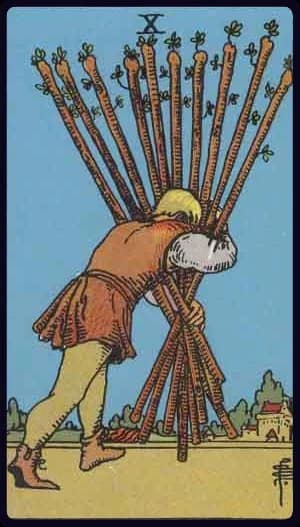
Ten of Wands
wands · 10
Keywords: overload, carrying it all, near the door — reversed: setting it down, delegation, collapse under load.
Ten of Wands in the Past position
Upright
This load was never handed to you whole; it accumulated behind you, one reasonable yes at a time.
In the past position, the Ten of Wands describes accumulation rather than an event. There was no single moment when someone assigned you everything you are now carrying. There were a series of small agreements, each defensible on the day it was made, and the arithmetic of them was never done in one sitting because nobody was keeping the running total.
The card sits at the end of the wands sequence, and that placement matters here. Everything in the bundle began as fire — an idea you were genuinely excited about, a project you volunteered for, a person you wanted to help. What you are carrying is not a punishment; it is the residue of enthusiasm that was never audited, and that origin gets forgotten once the weight is the only part you can feel.
The useful read of this position is that competence turned out to be self-punishing. You were good at the first thing, so you were given the second, and the reliability that carried you this far is the same trait that built the pile. Before deciding the load is a character flaw, notice that it is also a track record, badly filed and never once counted as one.
Reversed
Something already fell out of your arms once, and you have been over-correcting for it ever since.
Behind this position sits a load that ended rather than one that lightened. Either you set something down deliberately and paid for it in a reputation you have not fully rebuilt, or the carrying continued until the structure gave way — a missed deadline, a body that quit, a relationship that thinned out while you were busy being dependable. The Ten of Wands reversed remembers the drop far more clearly than the reason for it.
What tends to survive that episode is a rule, and the rule is almost always drawn too wide. People who dropped something once often conclude either that they should never carry anything again or that they should never let strain be visible again. Both are answers to the same past moment, and both cost more than they appear to on any single ordinary day.
There is also the version where the load was taken from you rather than released — a role reassigned, a responsibility quietly routed around you — and the relief arrived mixed with something closer to grief. That combination is hard to file, which is why it usually goes unfiled. Identifying which of these already happened is more useful than relitigating whether it was fair.
Ten of Wands in the Present position
Upright
You are now close enough to the door that stopping feels absurd, which is exactly the problem.
In the traditional image the figure carries ten staves gathered against the chest, and the bundle sits high enough to block the view of the road ahead of him. That detail is the present-tense reading of the Ten of Wands: the load is not only heavy, it is opaque. Right now you are probably navigating by memory rather than by looking, because looking would mean putting something down first.
The town on the horizon is usually painted close, and readers underplay that. You are not far from finishing, and proximity is precisely what keeps the current arrangement running. Every week the end is near enough to justify one more week at the same pace, and that justification gets renewed automatically, before anyone has a chance to examine whether it still holds.
The question worth asking today is not how to carry it more efficiently. It is which of the ten things in your arms is genuinely yours, which one you took on because refusing would have been awkward, and which one nobody has actually needed for months. That inventory takes about an hour and consistently outperforms any new system for carrying more.
Reversed
The load is negotiable now, and you keep re-signing terms that nobody is enforcing.
Currently this card inverted describes a moment where release is available and unappealing. The Ten of Wands reversed is the card of setting it down, and the reason people decline is rarely logistical. Handing something over means finding out whether it was ever load-bearing, and whether you are wanted around here for anything other than the carrying itself.
The other live version is a handover that moved only the visible half. You gave away the tasks and kept the vigilance, so the calendar cleared while the mental weight stayed exactly where it was. From outside this reads as generosity; from inside it reads as failure, and it explains why the relief you were promised has not shown up yet.
There is a third state that resembles rest and is not: the load did not get set down, it fell, and the current quiet is aftermath. If today consists mostly of not answering things, that is worth distinguishing from recovery. One of those ends in a decision you make, and the other ends with the same pile reassembled by whoever notices it first.
Ten of Wands in the Future position
Upright
The door is ahead, and what you choose to carry through it decides what the arrival feels like.
Ahead, the Ten of Wands describes an arrival rather than a rescue. The stretch you are in does end — a project ships, a season closes, someone finally takes their half back — and the card is unusually literal about this: the destination is reachable on the road you are already on. What it does not offer is any assurance that arriving changes the habit that got you here.
The specific thing coming into view is a threshold, and thresholds are where luggage gets decided. People who walk through the door still holding the full bundle tend to set it down inside and pick up an equivalent one within the month, partly because visible capacity attracts new weight and partly because empty hands feel unfamiliar rather than good.
So the forward work is a list made early: what genuinely ends when this ends, and what you have silently agreed to keep carrying afterwards. Write it while the weight is still on you, because the clarity available under load is a different clarity from the one available after relief, and relief has a habit of signing you up for the next round before you notice.
Reversed
Something ahead gets lifted off you, and the free hands will feel stranger than the weight did.
Coming toward you is a lightening you did not arrange. A role gets reassigned, a commitment dissolves, someone picks up the half you had been quietly covering — and the Ten of Wands reversed is honest about the fact that unearned relief is disorienting. A life organised around carrying does not immediately know what to do with an empty afternoon.
The less comfortable form ahead is a handoff you make badly. Delegation attempted while exhausted tends to become dumping: the work moves without its context, it comes back worse than it left, and the episode gets filed as evidence that handing things off does not work. That conclusion will feel earned, and it is the belief that keeps the pile intact for years.
Either way, the preparation worth doing now is an answer to the question that arrives once the weight is gone: what were you doing with yourself before this became the shape of your days. People who cannot answer refill quickly and call it circumstance. Naming one thing you want your hands free for is a small act, and it holds up better than a general intention to rest.
What if this card comes to you?
Pull three cards for your own question — past, present and future. Free, no account needed.