


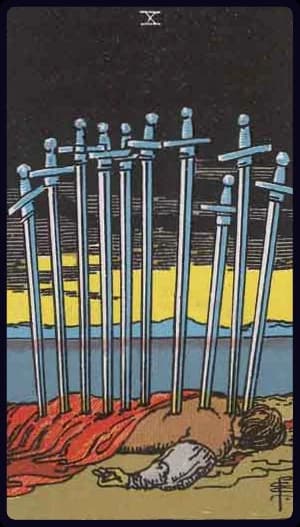
Ten of Swords
swords · 10
Keywords: bottom reached, final blow, it is over — reversed: slow recovery, refusing the end, first light.
Ten of Swords in the Past position
Upright
An ending behind you was complete, and that completeness is why you were able to build anything after it.
In the past position, the Ten of Swords marks something that finished all the way through — a job, a relationship, a version of yourself that did not survive the year it happened in. The detail worth noticing is that it did not linger. Whatever else it cost you, it stopped asking for maintenance, and a good deal of what you have built since was built with the attention that freed up.
The image is famously excessive: ten blades in a single back, when one would have done the work. That excess is the card being honest about how an ending feels from the inside rather than making a claim about the size of the event. Counting the swords is a way of insisting the loss was real, and people usually do that because someone once told them it was not.
Reading this position well means separating the finality from the story attached to it. The card does not say you were ruined; it says a chapter closed with no ambiguity left over, which is rarer than it sounds. Ambiguous endings are the ones that keep drawing resources for years afterwards. This one, already behind you, has not been charging you rent.
Reversed
Something already finished was never allowed to finish, and you have been paying its upkeep ever since.
The Ten of Swords reversed in the past describes an ending that arrived on schedule and was then quietly refused. The event happened; the acknowledgement did not. You kept a channel open, left one possibility unclosed, or told the story in a way that made it provisional — and the Ten of Swords reversed behind you converts that into a standing cost rather than a memory.
The other common form is a recovery that stretched far past the injury. Convalescence became somewhere to live. Friends stopped asking, the calendar moved on, and an identity built around being someone still healing outlasted the thing that caused the wound by a few years. There is nothing shameful in a slow return, but a slow return has a destination, and this one had stopped travelling toward it.
What this position offers is a date. Somewhere before now there was a moment when the thing actually ended, distinct from the moment you agreed that it had. The distance between those two points is the pattern worth examining, because it tends to reappear at every subsequent ending, and unlike the original event it is still open to revision.
Ten of Swords in the Present position
Upright
You are at the bottom right now, and the bottom happens to be the one surface that holds weight.
The Ten of Swords in the present position describes a situation where the worst has already happened rather than one still on its way. That distinction matters, because your nervous system is probably braced for an arrival — scanning the horizon, budgeting energy against a blow that landed some time ago and is currently being re-lived rather than survived.
The card sits at the end of its suit, and ten is where a long sequence of mental cutting exhausts itself. Nothing further can be removed from a position that has already been fully emptied, which is not a poetic consolation so much as an arithmetic one. The count is closed. Today the live question stops being how bad this gets and becomes what is actually still standing.
So the useful work is an inventory, done plainly: what is genuinely gone, what you assumed was gone and turns out to be merely damaged, and what was never involved in the first place. People in this position routinely write off things that survived, then spend a year mourning them. Doing that count now is worth more than another explanation of why the ending happened.
Reversed
This ending is over and you are still negotiating with it, pulling out one blade at a time.
This card inverted in the present points at an ending that keeps getting reopened for inspection. You return to the last conversation, revise your side of it, draft the message that would have changed the outcome. Each pass feels like processing and works like reinjury — the Ten of Swords reversed is the difference between a wound and a wound you keep checking on.
There is a second version, and from the outside it looks nothing like the first. Here the recovery is genuinely underway but slower than you can tolerate, and you have begun reading the slowness as failure. Sleeping more, working less, declining things you would once have accepted — the interpretation you are laying over that data is where the damage is now being done, not in the data itself.
Telling the two apart is straightforward, if uncomfortable. Ask whether today's activity moves you toward some future arrangement or back toward the moment of the blow. The first is convalescence and takes however long it takes. The second is rehearsal, and rehearsal has no natural stopping point, which is how it absorbs months without producing anything visible.
Ten of Swords in the Future position
Upright
What the Ten of Swords points to ahead is a clean ending whose relief is larger than the loss inside it.
What the Ten of Swords points to in the future position is a conclusion rather than a catastrophe. An arrangement you have been managing at real expense — propping up, explaining, working around — reaches the point where continuing to manage it stops being one of the available options. What is coming is less a decision you make than a fact you are handed.
Look at the background of the image rather than the body in the foreground: past the still water, the sky at the horizon has already begun to turn yellow. The card puts the ending and the first daylight inside the same frame deliberately. Whatever closes ahead, the closing is the mechanism by which the next arrangement becomes possible, and the gap between the two is usually shorter than people expect.
The preparation that actually helps is unsentimental. Decide in advance what you want to carry out of the situation — a working relationship, a skill, an honest record of what you learned — because those things are salvageable when handled early and almost never when handled late. An ending you can see approaching is far cheaper than one you spend your energy arguing with.
Reversed
Ahead is a slow return in which the daylight arrives well before you feel repaired.
Ahead, the reversed Ten of Swords describes the recovery rather than the blow, and recoveries carry a difficulty of their own. Something will start to lift — appetite, curiosity, the ability to sit through a meeting without drifting — noticeably before the internal weather catches up. This is the awkward interval where you look fine to everyone and are not there yet.
A second shape is worth naming in advance: the pull to restart something that has already concluded. It tends to present itself reasonably, often through a message or an opening that appears to reverse a conclusion you had already accepted. Nothing stops you from taking it up. It helps to remember that the conclusion was reached using information the invitation does not actually change.
What makes this position workable is deciding now what recovery will be measured by. Pick something observable — a routine restored, a piece of work finished, a conversation you can have without rehearsing it first. Otherwise the measure defaults to how you happen to feel on a given morning, and that number moves for reasons that have very little to do with the months in front of you.
What if this card comes to you?
Pull three cards for your own question — past, present and future. Free, no account needed.