


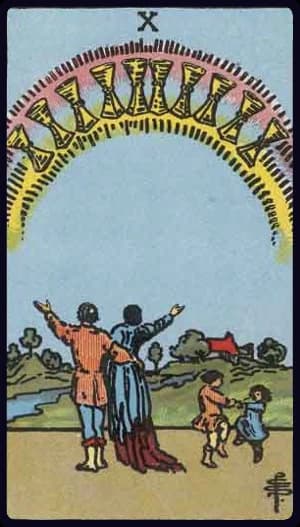
Ten of Cups
cups · 10
Keywords: belonging, shared home, emotional whole — reversed: picture-perfect strain, drifted family, unmet ideal.
Ten of Cups in the Past position
Upright
Somewhere behind you a group of people made you feel ordinary in the best way, and it set your standard.
In the past position, the Ten of Cups points at a stretch of time when belonging was not something you had to negotiate. A household, a shared flat, a team, a set of friends who assumed you would be there — whatever the arrangement was, it worked well enough that you stopped noticing it, which is usually the sign that something was genuinely holding.
The rainbow in the card sits above the scene rather than inside it, and that placement matters. Nobody in the image made the rainbow; they are standing under a condition that arrived and is being noticed. Much of what you learned about what a good life feels like was absorbed the same way — not built deliberately, but lived in and quietly recorded before you had any language for it.
The useful read here is about calibration. If an earlier experience of emotional wholeness set your reference point, you have been measuring every arrangement since against it, often without stating the comparison out loud. That standard is worth keeping, but it is worth making explicit, because an unspoken benchmark tends to produce disappointment that reads as a mood rather than a judgement.
Reversed
The family portrait behind you looked correct from outside, and the work of keeping it that way fell to someone.
Reversed in the past, the Ten of Cups usually describes a household that performed well and functioned poorly. The photographs were real, the holidays happened, and the strain lived underneath in a register nobody named. Anyone raised inside that arrangement learns early that appearance is a form of maintenance, and that maintaining it is a job with no title and no scheduled end.
The other shape this takes is drift — a group that did not break so much as thin out. Nobody had the argument, so nobody got the repair either. What ended instead was contact, one unreturned message at a time, until the connection was already historical before anybody had decided it was over. There is no scene to point at, which makes it unusually hard to grieve properly.
Either version leaves a specific residue. People who came through the first tend to distrust harmony and check what it is covering; people who came through the second tend to assume closeness expires on its own and stop maintaining it. Recognising which pattern you carry out of that time is more useful than reassessing who was responsible, because the pattern is the part still operating.
Ten of Cups in the Present position
Upright
Right now you are inside something good, and the risk is recognising it only in retrospect.
In the present, the Ten of Cups is one of the harder cards to act on, because it does not ask for a decision. It says the emotional arrangement you are currently standing in is more complete than you are treating it as — the people are there, the trust is real, and the ordinary Tuesday is not a placeholder for some better version arriving later.
Ten closes the sequence of the suit, and that number carries a particular difficulty: completion is quiet. Nothing announces it. The image shows a house at a distance and figures with their arms raised in the foreground, which is exactly the point — the celebration is not attached to an event, it is attached to noticing the configuration you are already inside.
The practical question today is what you are withholding while you wait to be sure. Half-presence is common at this stage — staying slightly reserved so that a loss would cost less, keeping one hand free. That reservation is currently the only thing making the picture incomplete, and it happens to be the single variable in the arrangement you fully control.
Reversed
You are currently maintaining an image of closeness that costs more than the closeness returns.
The Ten of Cups inverted in the present describes effort aimed at the wrong layer. The dinners get organised, the photographs get taken, the group chat is kept alive — and the one conversation everybody is avoiding stays untouched. Performing harmony is expensive work, and the bill is usually paid by whoever cares most about how things look from outside.
A second version runs today in a lot of households: a standard imported from somewhere else. Some picture of family life you saw or were told about is being used as the measure, and the actual people in front of you are marked down against a comparison they never agreed to. The ideal is not wrong, but it is unmet by construction, because it was never built for these particular people.
What is worth separating now is distance from difficulty. Some of what feels like drift is simply a season — work, illness, small children, a bad year — where contact thins without the caring thinning with it. Some of it is avoidance with a calendar built around it. The two call for opposite responses, and treating a season as a betrayal reliably converts one into the other.
Ten of Cups in the Future position
Upright
Ahead is a settling — less an arrival than the moment a group of people stops being provisional.
In the future position, the Ten of Cups describes consolidation rather than an event. Something currently treated as temporary becomes the arrangement: a house, a household, a set of relationships that stop being auditioned. It will probably feel less dramatic than you expect, because the shift runs from uncertainty into ordinariness, and ordinariness has no soundtrack.
This is the last cup in the suit, and what happens after a completion is worth thinking about before you get there. Emotional wholeness ahead does not mean the end of effort; it means the effort changes character, from proving to tending. People who miss that transition often go looking for fresh intensity somewhere else, because the settled version reads to them as boredom.
The preparation that actually helps is deciding in advance who is in the picture — not aspirationally, but by name. A future built around belonging tends to require choosing a smaller number of people and giving them considerably more, and that choice goes better made deliberately than left to whoever happens to still be replying next year.
Reversed
What comes next may look like the life you wanted and feel like an obligation you agreed to.
A reversed Ten of Cups ahead most often points at a version of the good life that gets adopted rather than chosen. The milestones will be legible from outside — the move, the shared address, the reunion everyone photographs — and somewhere in that sequence sits a decision taken because it came next rather than because anybody actually wanted it.
The other form is a slow separation whose opening moves are visible already. A relationship or a family group drifts further apart, not through conflict but through unallocated time, and the point where it becomes hard to reverse arrives well before anyone registers that it has. Distance of this kind compounds, and it does so quietly enough to pass for a busy stretch.
Neither shape requires a crisis, which is precisely why both are easy to postpone. The practical move forward is to name one specific person and one specific thing you will do about them inside a defined stretch of time. An unmet ideal does not get repaired in general terms; it moves only once it has been converted into something small enough to put in a diary.
What if this card comes to you?
Pull three cards for your own question — past, present and future. Free, no account needed.