


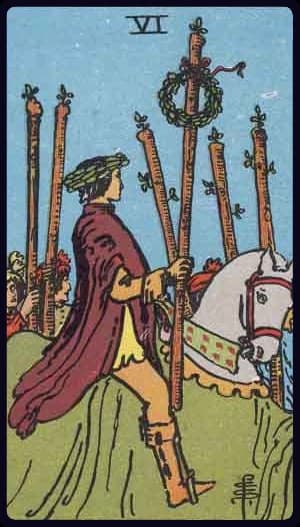
Six of Wands
wands · 6
Keywords: recognition, visible win, confidence — reversed: unseen effort, hollow praise, slipped lead.
Six of Wands in the Past position
Upright
A win of yours was seen by other people, and that visibility changed which doors opened afterwards.
In the past position, the Six of Wands points to a moment when something you did was noticed by people other than you — a project credited by name, a promotion announced in a room, a result that arrived with witnesses. The achievement mattered, but the witnessing is what did the structural work, because recognition is how private competence becomes a reputation other people can act on.
The image is a procession: a rider raised above a walking crowd, one laurel on his head and a second tied to his staff. Two wreaths, not one — the opinion he holds of himself and the opinion the street has granted him. What is easy to miss years later is that five of the six raised wands belong to other people. The win you remember as yours already had co-signers before it counted as a win.
The practical read here concerns what that old recognition bought and whether you have spent it. Reputations built on a past result do not renew themselves; they function as an introduction and then expire quietly, usually without anyone mentioning the expiry. If you have been living on the interest of something you did a while ago, the Six of Wands behind you reads less like a trophy and more like an invoice for a second visible result.
Reversed
Credit for something you carried went elsewhere, and you have been quietly billing the world ever since.
Reversed behind you, the Six of Wands usually marks work that was real and unattributed. You did the load-bearing part and someone else rode in the parade — the colleague who presented the deck, the manager who summarised your quarter as team effort, the friend whose version of the story became the one everybody now repeats. Nothing was stolen dramatically. It simply settled that way, and settling is harder to contest than theft.
There is a second, less obvious version of this past. Applause did arrive, and it landed on the easy part. You were congratulated for the polish and not for the eight weeks that made the polish possible, and hollow praise of that kind teaches something durable: that being seen and being understood are separate events, and that the first one is considerably cheaper to obtain.
Either shape leaves a habit that outlived the incident. Some people become archivists afterwards, timestamping contributions and narrating their own work until the narration costs more than the work did. Others go the opposite way and refuse to claim anything at all, which presents as modesty and operates as a bid to be noticed without having to ask. The original credit is not recoverable. The habit is the part still under your hand.
Six of Wands in the Present position
Upright
Right now you are being watched more closely than you think, and attention like this has a short shelf life.
Something you are doing at the moment is being observed by people whose read on you changes your options — a manager reconsidering what you are for, a client deciding whether to hand over the larger piece, a group that has started treating your opinion as the one that settles the question. The Six of Wands in the present is about that shift in altitude rather than about the work itself, which has probably not changed much.
Six follows five in this suit, and the order carries meaning. The friction card comes first and the procession second, so this is recognition that arrives after a scrap, not instead of one. The rider is currently elevated because the crowd is walking, and the crowd is walking toward its own destination. You are at the head of the street for exactly the length of the street.
The useful question today is one of conversion. Recognition is a currency with a live exchange rate and poor storage — it becomes a budget, a title, a piece of scope, a request granted without argument, or it becomes nothing at all within a quarter. Most people spend the window being gracefully modest and then wonder later why the standing never translated into anything structural. Naming what you want while people are still looking is the entire task.
Reversed
Either the applause you are getting does not reach you, or the work that actually matters is invisible today.
The Six of Wands inverted describes a gap between what is currently seen and what is actually being carried, and the gap runs in two directions. In one, you are being praised accurately for something you no longer care about, so the praise arrives and slides straight off. In the other, the thing you are genuinely pouring yourself into has no audience whatsoever right now, and the silence is starting to feel like a verdict on the work.
Hollow praise is not a trivial problem, because praise is a feedback instrument. Applause aimed at the surface tells you nothing about whether the substructure is holding, and after enough of it you lose the ability to calibrate on any external signal at all. The slipped-lead version is quieter still: a position held on reputation while current output stopped justifying it, which nobody mentions out loud because reputations are treated politely.
The test that separates the two is worth doing in writing. Describe in one sentence what you would want to be credited for this year. If the applause you are receiving now were aimed precisely at that sentence, would it land? A yes with no feeling attached means the goal has moved and needs replacing. A no means the visible work and the real work have come apart, and only one of them is currently being funded by anyone.
Six of Wands in the Future position
Upright
Ahead is a room where your work gets named out loud, and how you take it becomes part of the result.
What is coming is a change in who is watching rather than a change in what you can do. The Six of Wands ahead describes visibility arriving — an announcement, a public result, a piece of work that stops being privately yours and becomes something other people cite in rooms you are not in. The skill involved was already there. The audience is the new variable, and audiences behave differently from work.
Visibility is a condition with costs, and the value of seeing it in advance is being able to price them. Being known for one thing narrows what people bring you next, because a reputation functions as a filter as much as a door. The rider cannot step off the horse halfway down the street, and the version of you that gets recognised is the version that will be asked for again the following year.
There is a smaller decision to make before then, which is how you intend to receive it. Deflection is most people's default — crediting the team reflexively, changing the subject, treating a compliment as an awkwardness to be cleared. Take it plainly instead, and add one sentence about what you want next while the room is still oriented toward you. That sentence is the only part of the moment that does any work going forward.
Reversed
Something coming will be applauded loudly and count for little, unless you decide now what counts.
The version of this card that arrives inverted up ahead is usually quieter than a setback. The Six of Wands reversed in the future often means recognition that misses — you are named for the accessible half, a result gets attributed to good timing or to a team you barely worked with, or the thing lands and produces noticeably less than the anticipation around it suggested it would.
The other shape coming is a lead that thins while you are looking somewhere else. Nothing collapses. Someone is simply moving faster in the direction you assumed you owned, and by the time the gap is visible it is measured in months rather than weeks. This tends to happen wherever standing has quietly replaced effort, which is why confidence sits inside this card in both orientations rather than only the upright one.
The preparation that helps is unglamorous: build your own scoreboard before the recognition question arrives. Decide what a real result looks like in numbers, in shipped things, in problems that stopped recurring, so that external applause becomes information instead of a verdict. People who walk into a visible moment without that measure tend to accept whatever score the room hands them, and the room is not paying close attention to your actual work.
What if this card comes to you?
Pull three cards for your own question — past, present and future. Free, no account needed.