


Six of Swords
swords · 6
Keywords: passage, leaving turbulence, guided move — reversed: unfinished exit, carried baggage, stuck mid-crossing.
Six of Swords in the Past position
Upright
You left something turbulent behind without a scene, and the quiet of that exit hid how much it cost.
In the past position, the Six of Swords marks a departure that produced no story worth telling — no confrontation, no final speech, just the slow moving of your things to a different shore. Because nothing dramatic happened, that exit rarely gets counted as an accomplishment, and the effort it took went unrecorded by everyone, including you.
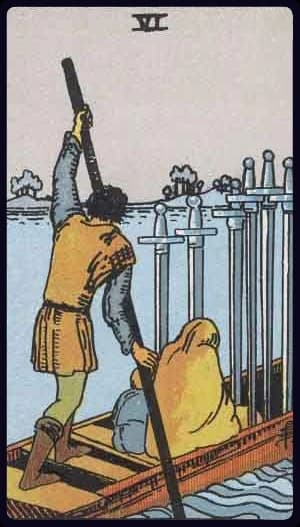
The image is unusually literal for a swords card. Six blades stand upright in the floor of the boat, travelling with the passenger rather than staying on the bank behind. Whatever you understood back then about why the situation had to end, you took it with you, and that understanding is still the reason you have not gone back.
What is worth crediting is that the crossing was steered. Someone poled the boat — a friend, a counsellor, a lawyer, a sibling who drove the van — and you let them. People who describe their earlier escapes as things they managed alone tend to refuse help the next time, which makes every later crossing much longer than it needs to be.
Reversed
An earlier crossing stalled halfway, and some part of you has been living on the water ever since.
Reversed in the past, the Six of Swords describes a leaving that was announced and then suspended. The bags were packed, the decision was said out loud to at least one person, and then the situation absorbed you again — not through force, but through the ordinary gravity of an arrangement that already existed.
The second form of this is a geographic success with no internal departure. You did move. What travelled with you was the entire inventory: the grievance rehearsed in the shower, the drafted message never sent, the habit of reading every new room for the old danger. The boat arrived and nobody actually got out of it.
This position matters because it explains a present-day allergy. Someone whose earlier exit never completed tends to distrust calm water, reading quiet as a lull before the next impact rather than as arrival. Working out which of the two versions happened is more useful than relitigating the original situation, which is closed.
Six of Swords in the Present position
Upright
Right now you are mid-water, and the flatness you feel is the crossing working rather than failing.
Currently the Six of Swords describes motion you can barely detect. Nothing is resolving dramatically, no one is apologising, and the days have taken on a grey, procedural quality — laundry, commute, a slightly better night's sleep than last month. That texture is what a passage actually feels like from inside it.
In the picture the water behind the boat is choppy and the water at the prow is smooth, and the passenger does nothing at all during the transit. This is one of the rare cards where inaction is the correct behaviour. The ferryman is not a rescuer; he is a function that has been engaged, and the work today is to stay seated.
The live risk is boredom misread as stagnation. Numbness after a turbulent period is uncomfortable in a way that conflict is not, and the fastest cure for it is to reopen the old argument, message the person, or manufacture a fresh emergency. What this card asks now is that you tolerate the dullness a while longer.
Reversed
You keep steering back to check on a shore you have already decided to leave.
The Six of Swords inverted puts you mid-channel with the oars pointed the wrong way. Something has been left in principle and is still being maintained in practice — a group chat you have not muted, a shared account, a weekly check-in that exists mainly to confirm the other party is coping without you.
The other version currently in play is overload. The Six of Swords carries six blades and no more; a boat sits low in the water when the passenger insists on bringing every explanation, every artefact, every version of who they were in the previous arrangement. A crossing like that does not fail loudly. It just becomes unbearably slow.
A blunt test for today: name one thing you would have to give up permanently for this move to be finished, then notice how fast you produce a reason it should be an exception. That reason is the whole problem. Reversed here, the card is asking less for a cleaner break than for an honest count of what is still aboard.
Six of Swords in the Future position
Upright
Ahead is a passage toward quieter water that will feel far more like relief than like triumph.
In the future position, the Six of Swords points to a move that becomes available rather than a victory that arrives. A route opens — a transfer, a lease, a change of city or of the people you see weekly — and it will be undramatic enough that you may not register it as the significant thing it later turns out to be.
Two features of the coming passage are worth knowing in advance. It will be assisted, meaning someone offers to steer part of it, and it will be incremental, meaning the improvement shows up as fewer bad evenings rather than as a new life. Neither of those makes it small; both make it very easy to undervalue at the time.
The preparation that helps is deciding what you intend to bring. Six swords fit in that boat and no more, so the question ahead is which understandings are worth transporting and which were only ever useful in the old water. People who answer this before departure tend to arrive lighter and stay where they land.
Reversed
A departure coming up may be announced several times before any of it actually happens.
Reversed in the future, this card describes an exit that keeps being scheduled. The date moves, the conditions get refined, and each postponement carries a legitimate reason — a bonus not yet paid, a lease not yet up, a relative not yet well. Every reason will be true, and the pattern rather than any one reason is the point.
The second shape coming is a crossing completed on paper and undone in practice. You reach the far bank and rebuild the previous arrangement with new participants, because the Six of Swords inverted tends to move the setting while leaving the cargo untouched. Watch for this if the current situation ends unresolved rather than concluded.
What makes either version workable is a decision made early rather than in the moment. Write down now what would count as having left — a specific severed thread, a returned key, a conversation you will not have again — so the departure ahead has a definition. Exits without one are the exits that repeat.
What if this card comes to you?
Pull three cards for your own question — past, present and future. Free, no account needed.