


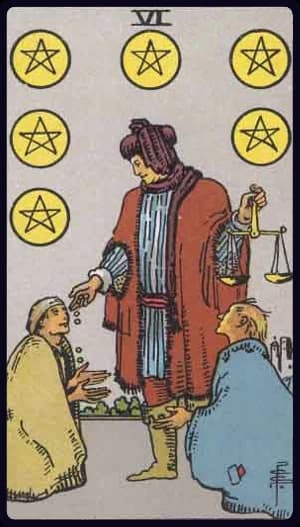
Six of Pentacles
pentacles · 6
Keywords: giving and receiving, fair exchange, support — reversed: strings attached, one-way flow, debt.
Six of Pentacles in the Past position
Upright
Someone put something in your hands before you could repay it, and it is still in the accounts.
In the past position, the Six of Pentacles points at a transfer that already happened — money, a recommendation, a spare room, six months of somebody's patience. It was not symbolic. Something moved from one side to the other and the balance of your life shifted afterwards, and you have probably filed it under a general sense of having been lucky rather than under the specific person who handed it over.
The card shows a merchant holding scales in one hand while coins fall from the other, and the scales matter more than the coins. What arrived before now came measured — somebody decided how much, and decided it in your favour. That decision was theirs to make and not yours to earn, which is why the obligation it created is not the ordinary kind that a repayment closes.
The practical read here is about accuracy rather than gratitude. If you narrate your history as entirely self-made, you lose the ability to see the same mechanism working around you now, and you will misread the next person who extends something. The Six of Pentacles behind you says a hand was open at a moment when yours was not, and that fact belongs in the record.
Reversed
Help you took years ago came with terms, and you have been pricing every offer since.
The Six of Pentacles inverted in the past marks an exchange that never balanced. Often it is support that arrived with quiet conditions attached: a loan that came with opinions, a favour that turned into a permanent reference point in arguments, family money that bought a say in decisions it was never meant to reach.
The other version runs the opposite direction. You were the one giving — time, cover, money, attention — into an arrangement that only ever flowed one way, and you kept going because stopping would have made the imbalance visible to everybody, including yourself. Both versions leave behind the same residue, which is a standing suspicion of open hands.
What this position explains is a present-day habit rather than an old wound. Behind you sits a ledger somebody kept badly, and now you either refuse help you actually need or over-give in order to stay in the position of creditor. Naming which side of the Six of Pentacles you learned to stand on is more useful than relitigating who owed whom.
Six of Pentacles in the Present position
Upright
Right now you are standing on one side of a scale, and the position is temporary by design.
In the present, the Six of Pentacles describes a live arrangement with a measurable direction: somebody is currently supporting you, or you are currently the resource somebody else is drawing from. It rarely announces itself as a dramatic situation. It looks like who pays, who drives, who answers the message at eleven at night.
The image sets the merchant standing and two figures kneeling, and readers routinely treat that as a fixed hierarchy. The number six sits in the middle of the suit's sequence rather than at its end, which reframes the scene as one moment in a cycle. Whoever holds the scales today held out a hand at some earlier point to get them.
So the useful question now is not whether the exchange is generous enough. It is whether it is honest — whether both people could state the terms out loud in roughly the same words. Support that cannot be described plainly by both sides has usually stopped being support. Under the Six of Pentacles, an arrangement stays clean exactly as long as it stays sayable.
Reversed
The flow currently runs one way, and the person keeping the ledger is not saying so out loud.
The Six of Pentacles inverted in the present is about an imbalance everybody involved has quietly agreed not to mention. In one form you are giving and calling it generosity while keeping a private count, which converts each gift into an unbilled invoice — one that gets presented at the worst possible moment, usually during an unrelated argument.
In the other form you are receiving on terms you have not actually read. The support is real and the strings are real, and today they are loose enough to ignore: a job through a friend, a subsidised flat, a partner covering more than their share of everything. The Six of Pentacles reversed does not call this exploitation. It calls it unexamined.
Both forms share one symptom worth checking right now, which is that the exchange has stopped being discussable. If you cannot raise the money, the hours or the effort without it turning into a scene, the scales in the Six of Pentacles have already tipped, and the correction is a plain conversation rather than a grand gesture in either direction.
Six of Pentacles in the Future position
Upright
Something ahead puts you on the giving side, and the terms you set will outlast the gift.
The Six of Pentacles in the future position describes an exchange coming into range rather than a windfall landing. Support becomes available — somebody with resources takes an interest, an institution says yes, a person offers what you have been managing without. Or the mirror of it: you become the one with enough to spare, and you get asked.
What makes this readable in advance is that both roles belong to the same card. Coins moving toward you and coins leaving your hand are drawn identically in the image, and the only difference is which side of the scales you occupy that year. Whichever position you take next, the arrangement will need limits that somebody actually says aloud.
The preparation is unglamorous: settle now on what you will genuinely accept, and what you can give without needing it noticed. Decided in advance, those two limits hold under pressure. Improvised in the moment, they follow whichever feeling is loudest — pride on the receiving side, guilt on the giving one — and the Six of Pentacles ahead rewards the version you set calmly.
Reversed
An offer coming toward you carries terms, and its real cost will not be listed in money.
A reversed Six of Pentacles ahead most often describes assistance that arrives with an expectation attached. Nobody states it. The help is genuine, the giver may not be fully conscious of what they are buying, and the price surfaces months later as an assumption about your availability, your loyalty, or your agreement on something unrelated.
The second shape is a debt of your own coming due, and not necessarily a financial one. Something you accepted, or somebody you have been carrying, reaches the point where the imbalance stops being sustainable and asks to be settled. This tends to show up as fatigue well before it shows up as a conversation, which is why it is worth watching for.
Neither version needs to be refused on sight. What the Six of Pentacles reversed suggests about the road ahead is that you ask the unfashionable question early — what does this cost, and when — rather than after you have restructured your life around the assumption that it was free. Terms named at the start rarely turn into resentments later.
What if this card comes to you?
Pull three cards for your own question — past, present and future. Free, no account needed.