


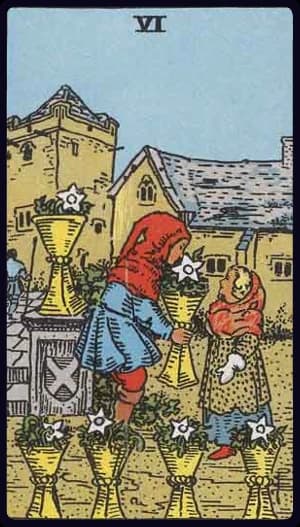
Six of Cups
cups · 6
Keywords: nostalgia, innocent gift, familiar comfort — reversed: stuck in the past, rosy distortion, outgrown.
Six of Cups in the Past position
Upright
Someone gave you something early on without asking for anything back, and it set your baseline.
In the past position, the Six of Cups points to an exchange that happened before you were old enough to keep score — a kindness, a shelter, a person who handed you something and did not itemise the cost. The card shows one child passing a cup of white flowers to another inside a walled garden, and the detail that matters most is the complete absence of terms.
What you carried forward from that is not the object but the calibration. Whatever was given freely became your reference point for what safety feels like, and you have been quietly measuring rooms, jobs and relationships against it ever since. That reference usually stays invisible until something in front of you fails to match it and you cannot explain why the mismatch stings.
The useful read here is that the garden is behind you and the calibration is not. If your standards for warmth strike other people as unreasonable, they may simply be accurate to a period you actually lived through. What is worth sorting is which parts of that early comfort were real conditions someone built for you, and which were the shortness of your own sightline at the time.
Reversed
A stretch of your history has been retold so often that the retelling replaced the record.
Reversed in the past, the Six of Cups usually describes an edit rather than an event. There was a period — a relationship, a city, a household, a job you were good at — and the version you carry has been smoothed by repetition until the difficult parts no longer load with it. Nostalgia works as a compression algorithm, and it discards on a fairly predictable schedule.
The second shape this takes is heavier. Sometimes an early bond was not actually safe, and you were nonetheless expected to describe it fondly, at dinners and in front of people who needed the story to hold. Being handed the official version before you had language of your own leaves a specific gap, where the feeling and the account of the feeling never quite line up.
Neither version calls for demolition. What has already happened is not available for revision, but the archive is, and the point of reopening it is accuracy rather than verdict. A memory that includes its own rough edges tends to carry weight better than a polished one, and it stops recruiting you into comparisons that anything currently in front of you is structurally unable to win.
Six of Cups in the Present position
Upright
Something simple is being offered to you now, and your first instinct is to look for the invoice.
Right now the Six of Cups is describing an offer with nothing attached to it — a message from someone who knew you before you were impressive, an invitation back into an old room, help extended without an account being opened. The difficulty is not the offer itself. It is that you have become fluent in transactions and this one does not parse cleanly.
The six cups in the image hold white flowers rather than wine, which is a strange choice for a suit about feeling. Flowers do not keep and cannot be banked. What is on the table today is worth something precisely because it will never accrue interest, and treating it as an asset to be evaluated is the most efficient way to let it pass unused.
There is a practical version of this currently in play as well. Some skill or comfort from your earlier life is quietly load-bearing again: the language you half-learned, the craft you dropped when it stopped being impressive, the friendship you let go dormant. Familiarity is not the same thing as regression, and drawing on what you already have is the least glamorous form of resourcefulness available.
Reversed
You are measuring a live situation against an edited memory, and the live one keeps losing.
The reversal in the present tends to run as a comparison in the background rather than a thought you have deliberately. There is a current relationship, role or city, and beside it a version of an earlier one curated down to its best hours. The Six of Cups inverted does not claim the earlier thing was bad; it says the comparison is not being conducted between equals.
A second form is the maintenance of something you have already outgrown — a friendship running on shared history alone, a role you accepted at twenty-three and still perform, a family script you deliver on schedule every holiday. It works, in the narrow sense that nothing visibly breaks, and that is exactly why it can go unexamined for years at a stretch.
The test worth running today is short. Name one thing about the remembered version that was genuinely inconvenient, and one thing about the present arrangement that is actually better. If the first is hard to produce, you are holding an advertisement rather than a memory. If the second is hard, the comparison may be fair after all, which is its own useful piece of information.
Six of Cups in the Future position
Upright
Something from earlier circles back ahead, and your part in it is to give rather than collect.
In the future position, the Six of Cups describes a return rather than an arrival. A person reappears, an old thread resurfaces, a place you left puts something back into your hands. What is coming is not new material — it is material you already own, presented at a moment when you finally have the standing or the calm to do something with it.
The overlooked detail in the traditional image is direction. The larger figure is handing the cup down rather than receiving it, and the future reading generally puts you in that role. You will be the one holding something worth passing on: the introduction, the small loan, the two hours of attention that cost you little and land far heavier than you expect.
The way this goes wrong in advance is by pricing it. An exchange conducted without terms belongs to a different category than a favour with a ledger running behind it, and people register the difference immediately even when nothing is said aloud. Deciding now that this particular one runs without an invoice is most of the work the card is actually asking for.
Reversed
An old door opens ahead, and familiarity will make a poor case sound like a good one.
Reversed in the future, this card tends to describe a re-entry offer. Something you left makes itself available again — the ex, the former employer, the town, the version of yourself that required less explaining. The Six of Cups inverted is not opposed to return in principle; it is opposed to returning on the strength of recognition alone, which is a weak reason wearing a strong one's coat.
The mechanism deserves naming because it is fast and it impersonates intuition. Familiar things are cheaper to process, and the mind reads that ease as rightness. Next time an old option lands on the table, the sensation of already knowing how it works will arrive well before any honest assessment of whether it still fits the person you have since become.
There is a quieter version too, in which nothing returns at all and you spend the coming season designing a future that is really a reconstruction — the same house, the same arrangement, staged again with better lighting and a larger budget. Writing down what you want that you have never actually had is a reasonable defence against building a replica by default.
What if this card comes to you?
Pull three cards for your own question — past, present and future. Free, no account needed.