


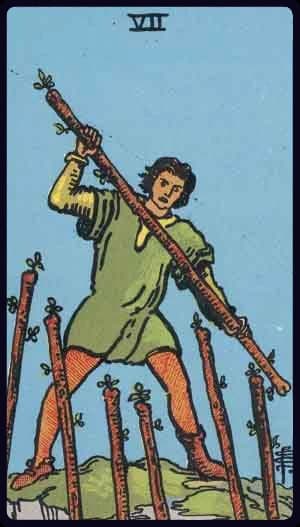
Seven of Wands
wands · 7
Keywords: defending ground, holding position, pressure — reversed: overwhelmed, giving ground, picked wrong hill.
Seven of Wands in the Past position
Upright
Something you refused to hand over is the reason the ground under you is yours.
In the past position, the Seven of Wands points to a stretch where you were outnumbered and did not step back. A claim, a standard, a project, a version of yourself that other people found inconvenient — you kept it, and the keeping was expensive in ways that were mostly invisible to anyone watching.
The card shows a figure on raised ground, six staves pushing up from below, and one pair of mismatched shoes that readers usually skip past. The detail matters: the defence was improvised. You were not equipped for the challenge before it arrived, and you held anyway, which is a different competence from being prepared.
What is worth recovering from this is the accounting. People who have already survived a long defence tend to describe it as a bad period rather than as evidence, and so they carry the exhaustion forward without the credential. The ground you stand on was not handed to you; it was held, and the person who held it is still here.
Reversed
A position behind you was abandoned, or was defended long after it stopped being worth defending.
The Seven of Wands reversed in the past describes a fight that ended badly in one of two directions. In one, you conceded — quietly, reasonably, with good arguments for why the thing was not worth the friction — and that concession has been running as a background assumption ever since about what you are willing to contest.
The other direction is the wrong hill. You held something well past the point where it served you: a role, an argument, a grievance with a former employer or a former friend. The Seven of Wands reversed is unusually specific about this failure mode, because the energy spent looks identical whether the position was worth it or not.
Both leave a similar residue, which is why they are hard to tell apart from inside. Someone who gave ground early flinches at conflict; someone who defended too long treats every disagreement as a siege. Naming which one happened before is more useful than relitigating it, since the old fight is closed and the reflex it installed is not.
Seven of Wands in the Present position
Upright
You are holding a position right now against steady pressure, and the pressure is not evidence that you are wrong.
Right now the Seven of Wands describes sustained opposition rather than a single confrontation. Nobody has attacked you outright. What is happening is attrition — repeated questions, small revisions requested, a tone in meetings, a relative's steady commentary — and the cumulative effect is that you spend energy justifying something you already decided.
The number seven in this suit is the point where fire meets resistance. Six was recognition; seven is what happens after recognition, when having something visible means having something contestable. That progression is not a punishment for succeeding. It is the ordinary tax on holding anything that other people also want.
The practical question today is not how to make the challengers stop. It is whether you can state, in one sentence and without heat, what specifically you are defending. Defences that cannot be stated compactly tend to drift into defending your right to have been right, which costs considerably more and secures considerably less.
Reversed
Too many fronts are open at once, and defending all of them currently costs more than any single one is worth.
Inverted in the present, the Seven of Wands usually means the defence has spread. You are contesting a workload, the tone of an email, an old family expectation and a stranger's opinion in the same week, and each individual case is arguably legitimate. Together they consume the entire supply, and nothing ends up secured.
There is a second shape this takes now, quieter than the first. The staves get lowered — you stop arguing, accept the revision, let the boundary move a few inches — and you call it maturity. Sometimes it is. The test is whether the concession freed you or simply moved the same negotiation to a later date on worse terms.
Fire reversed does not go out; it scatters. What this position asks for today is triage rather than resolve: one thing you will hold without further discussion, and an explicit list of what you are releasing, so that the release is a decision instead of an erosion you notice half a year later and cannot account for.
Seven of Wands in the Future position
Upright
Something ahead will ask you to hold a position without much company, and the high ground is already yours.
In the future position, the Seven of Wands describes a challenge that is coming rather than one that appears from nowhere. Something you have built, chosen or said is going to be contested — by a colleague, an institution, a person with a competing claim — and the contest will be a matter of persistence rather than one dramatic exchange.
The figure in the image stands above the wands, which is the structural advantage this card keeps insisting on. Elevation is not popularity; it means you already occupy the thing being argued about, and the other side has to climb. Whoever holds the position sets the cost of taking it, and that cost is usually fixed in advance rather than in the moment.
The preparation that makes this go well is unglamorous. Decide next what you will not negotiate and what you will trade cheerfully, because a defence with no trading floor reads as rigidity while one with no floor at all simply collapses. Fatigue, not opposition, is what generally settles these things, so budget for the long version.
Reversed
What is coming is less a defeat than an attrition: ground given quietly, or effort spent on the wrong hill.
A reversed Seven of Wands ahead points at exhaustion rather than confrontation. The likely sequence is not that you lose an argument; it is that you stop having it. A boundary gets renegotiated in small increments, each concession reasonable in isolation, and at some point the position has moved without any moment you could name as the surrender.
The alternate form is misallocation. Energy goes toward a dispute that will not matter in two years, while the thing that does matter goes undefended precisely because it never produced a confrontation loud enough to notice. Wands burn hot in either direction; what the reversal removes is accuracy about where the fire should point.
The counterweight to both is setting criteria before the pressure arrives rather than during it. Write down what would make a concession acceptable — a condition, a limit, an exchange — so that when the moment comes forward you are consulting a decision instead of your energy level that day. Tired people concede on schedule; prepared people concede on purpose.
What if this card comes to you?
Pull three cards for your own question — past, present and future. Free, no account needed.