


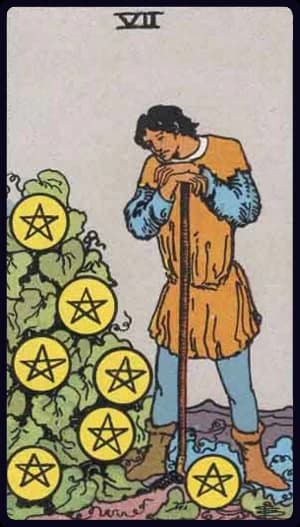
Seven of Pentacles
pentacles · 7
Keywords: patience, tending the crop, mid-term review — reversed: impatience, wrong field, sunk cost.
Seven of Pentacles in the Past position
Upright
A long stretch of unglamorous maintenance in your past is why there is anything worth assessing today.
In the past position, the Seven of Pentacles points to a season of work that produced almost no visible result while it was happening. Months of showing up, small corrections, nothing photogenic. The vine in the image did not grow on the day the figure leaned on his hoe to look at it; it grew across every unwatched day before that.
What that period actually built was less the crop than the temperament. Patience of this kind is not a trait people are born holding; it is a skill acquired by staying with something past the point where it stopped being interesting. You already did that once, which makes it documented rather than theoretical.
The trap in reading this position is nostalgia, treating the slow years as dues paid rather than as evidence. The Seven of Pentacles keeps an honest ledger: something compounded because you did not abandon it early, and whatever you are weighing now can be measured against that record instead of against a fear that you lack staying power.
Reversed
Behind you is a field you kept working long after you had reason to believe the soil was wrong.
Reversed in the past, the Seven of Pentacles usually describes an investment that outlived its own reasoning. The years already spent became the argument for the next year, and each renewal was justified by the size of the deposit rather than the quality of the return. Sunk cost is rarely felt as an error; it is felt as loyalty.
There is a second version, less discussed: a field abandoned too early. Something was three seasons from yielding and got pulled up at two, because the absence of visible growth was read as the absence of growth. The pentacles on that vine ripen at their own rate, and impatience at that stage looks identical to good judgement from the inside.
Either way the residue is a distorted sense of time. Whoever leaves early tends to keep leaving early; whoever overstays learns to distrust their own read on when to stop. Naming which one happened matters more than relitigating the decision, because the decision is closed and the calibration it left behind is still running everything.
Seven of Pentacles in the Present position
Upright
You are at the point in the work where looking at it carefully is the work, and it does not feel like progress.
In the present position, the Seven of Pentacles finds you leaning on the handle of something you have been building, mid-effort, with the results only partly in. Nothing is finished and nothing has failed. This interval is genuinely uncomfortable, because effort is legible and waiting is not, and right now you are being asked to do the second one.
The card's number sits at the seventh step of a ten-part suit, deliberately short of the end. What it asks for today is a review rather than a verdict: which of the seven pentacles on that vine came from your attention and which grew regardless, what is actually returning value, and what you have been tending purely out of habit.
The practical distinction here is between patience and passivity. Patience has a checkpoint and a short list of things it is watching for; passivity simply keeps going. If you cannot currently name the evidence that would tell you this is working, the waiting has no instrument in it, and building that instrument is the real task of this position.
Reversed
Right now the counting has replaced the growing, and the checking itself is costing you the yield.
The Seven of Pentacles inverted in the present describes a specific restlessness: pulling the plant up to inspect the roots. You refresh the numbers, re-read the same feedback, measure a thing whose timescale is far longer than your patience for it. The Seven of Pentacles reversed understands that measurement at the wrong frequency is itself a form of damage.
The other shape it takes today is effort correctly applied to the wrong ground. The work is real and the discipline is real, and the field will not yield no matter how well it is tended, but stopping would mean writing off everything already put in, so the tending continues as a way of postponing the accounting.
Both versions share a refusal to look straight at return. One refuses by looking too often, the other by never looking at all. A useful move now is to write down what you expected this to produce by this date, as you would have described it before you knew how much you would end up investing, and then read that figure as a stranger would.
Seven of Pentacles in the Future position
Upright
A checkpoint is coming where you decide whether to keep tending this or move the effort somewhere else.
In the future position, the Seven of Pentacles describes an assessment rather than a payoff. Something ahead reaches the stage where early returns are finally readable, not conclusive but readable, and you will be able to tell the difference between slow and stalled for the first time since you started.
What is coming is not a harvest. The vine still holds its pentacles and the ground is still doing its slow work; the card simply marks the moment the gardener stops and stands upright. Expect it to feel anticlimactic. Genuine mid-term reviews rarely arrive with drama, which is exactly why they are so easy to skip in favour of just continuing.
The preparation that makes this position useful is choosing the criteria now, while nothing is yet at stake. Decide what a good enough result looks like at that checkpoint, and what you do if it is not met. Settling it in advance keeps the review from becoming a ceremony that ratifies whatever you had already intended to do anyway.
Reversed
Ahead sits the pull to quit one season early, or to re-sign for reasons made entirely of history.
The reversed Seven of Pentacles in the future position marks a stretch where the return runs late and the patience runs out slightly before the crop does. Nothing dramatic announces it. There will simply be a week when continuing feels absurd and the reasons for stopping arrange themselves neatly, and the arrangement will be persuasive.
The mirrored risk is a renewal made out of accounting rather than appetite. Something ahead asks for another commitment, another year, another round of spending, another version of the same arrangement, and the case for yes gets built almost entirely from what has already gone in rather than from what is plausibly still to come.
The card does not say which of the two is yours, and that ambiguity is the whole reason to prepare early. Set the exit condition and the extension condition while the field is still green: a date, a threshold, a specific signal you would accept as an answer. A rule written before impatience arrives is the only one impatience cannot argue with.
What if this card comes to you?
Pull three cards for your own question — past, present and future. Free, no account needed.