


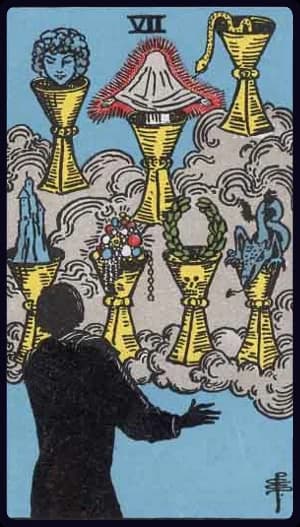
Seven of Cups
cups · 7
Keywords: many options, fantasy, unclear wanting — reversed: clarity, picking one, disillusion.
Seven of Cups in the Past position
Upright
Much of what you call your life was chosen from a menu you never fully read.
In the past position, the Seven of Cups describes a stretch when everything felt available — several careers, several cities, several versions of who you could become — and you selected one of them without ever comparing them fairly. The others were never real enough to lose, so you have never counted them as losses.
The card shows seven vessels rising out of a cloud, and the cloud is the operative detail: those offers were suspended in imagination rather than standing on a table. What you weighed back then were not options but moods, each one carrying its most flattering lighting, and the one you took has since had to survive daylight.
Reading this position usefully means separating two facts that got fused together long ago. You made a choice, and you also invented most of what you were choosing between. The life that followed was built on the first fact; the low-grade dissatisfaction that visits you belongs to the second, and it is far easier to set down once it has the right name.
Reversed
A fantasy collapsed behind you, and you have been careful about wanting things ever since.
Reversed in the past, the Seven of Cups usually marks a deflation rather than a decision. Something you had built up in your head — a person, a company, a plan you rehearsed for years — turned out to be ordinary at close range, and the disappointment attached itself not to that one thing but to the act of imagining at all.
A quieter version is that you did pick, cleanly and early, and the picking was never the problem. What happened afterwards is that you stopped letting yourself look at the other cups, on the theory that looking is what causes the trouble. That is a workable rule for a while, and it costs considerably more than it appears to.
Either way, the residue is a suspicion of your own appetite. Someone fooled once by their own imagination tends to treat every later want as a possible trick, which produces a person who is very hard to sell to and equally hard to satisfy. That reflex formed before the situations you are handling now, and unlike the original disappointment, the reflex is still open to revision.
Seven of Cups in the Present position
Upright
You are not currently choosing between options — you are choosing between descriptions of them.
In the present position, the Seven of Cups points at a decision you are running entirely inside your head. Right now there are three or four possible directions, and you keep comparing them by picturing each one on a good day, which is why the comparison never resolves: every candidate wins whichever round it is being imagined in.
Look at what the traditional image actually holds. Among the seven cups sit a wreath of victory, a hoard of jewels, a castle, a veiled figure and a serpent — rewards and hazards drawn at identical size, all of them floating, none of them weighed. The chooser is rendered as a black silhouette, unidentifiable even to himself.
The practical move today is not further analysis but a change of unit. Ask what each direction demands on an average Tuesday rather than what it delivers at its peak, then ask which of them you actually want as against which you would like to be the sort of person who wants. Those two questions tend to empty most of the cups without any additional deliberation.
Reversed
Something has come into focus, and it is worth checking whether that is clarity or fatigue.
The Seven of Cups inverted in the present describes the cloud thinning out. Directions that looked equally alive a month ago no longer do; one has become obviously heavier than the rest, or the whole array has lost its shine at once. From the inside both of those feel like clear sight, and only one of them is.
Genuine clarity is specific. You can state what you are taking and what you are putting down, and the putting-down half carries a real cost you can name out loud. The other kind is closure under pressure: holding several open possibilities became intolerable, so you narrowed the field to end the discomfort and are now calling that relief conviction.
Disillusion also lives in this reversal and deserves separate handling. If nothing currently looks appealing, that is information about your capacity to want at this moment rather than a verdict on what is in front of you. Choosing from inside a flat mood reliably produces something small, safe and defensible that you did not really mean, and flat moods are poor negotiators on your behalf.
Seven of Cups in the Future position
Upright
More will be offered to you than you can take, and the surplus is the actual difficulty.
The future position gives the Seven of Cups its most awkward shape: abundance arriving as a problem. Several things become available inside a short window — offers, invitations, people, directions — and none of them are bad, which is exactly what makes the stretch ahead harder than a shortage would be. Scarcity decides for you; plenty declines to.
What is coming will not sort itself by quality, because the cups are not ranked. The card's seven vessels hang at the same height in the same cloud, and the one holding a laurel wreath is given no more prominence than the one holding a snake. You will be doing the ranking yourself, in real time, on partial information about each.
The preparation this position rewards is unglamorous. Decide your criteria before the options appear — the two or three conditions that would make something worth your next few years, whether that is money, location, autonomy or whoever you get to work beside — and then hold them steady. Criteria set in advance survive contact with a shiny offer; criteria improvised on the spot rearrange themselves around whatever is nearest.
Reversed
Ahead, one image loses its glow, and what you do in the week after matters more than the loss.
A reversed Seven of Cups in the future position often means a picture you have been carrying quietly gets corrected. The role, the city, the relationship you have imagined in some detail turns out at close range to be a normal thing with normal problems, and the particular pleasure of anticipating it will not be replaced by anything.
The risk in the period that follows is overcorrection rather than sadness. People who have just watched a fantasy deflate frequently conclude that all their wanting was foolish, and then make their next several decisions from an unusually cynical position, taking the dullest available option precisely because it cannot disappoint them. That is the same error with its sign flipped.
The other form this takes is a choice made too fast. Something forces the issue before you are ready, you pick against a deadline, and the speed gets remembered afterwards as decisiveness. If that is how it goes, the useful thing is to leave the door open on what you set aside instead of building a case for the pick — the version of you who chose in a hurry was not lying, only short of time.
What if this card comes to you?
Pull three cards for your own question — past, present and future. Free, no account needed.