


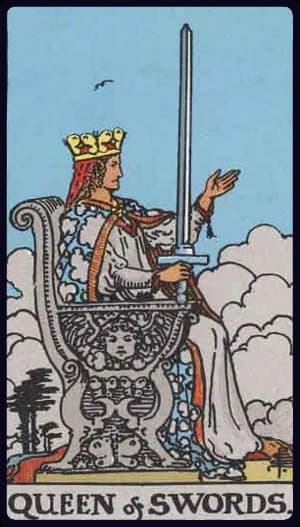
Queen of Swords
swords · 13
Keywords: clear boundary, unsentimental read, honesty — reversed: coldness, cutting for sport, walled off.
Queen of Swords in the Past position
Upright
Somewhere behind you, you stopped softening a sentence, and the clarity cost you something worth paying.
In the past position, the Queen of Swords marks the point where you began saying the accurate thing instead of the comfortable one. Often it was a single conversation — a resignation delivered without padding, a diagnosis repeated out loud, a friendship named honestly rather than nursed along. The room got colder and it also got considerably clearer.
The card shows her seated with the sword upright and the other hand open, and that pairing is the whole argument. The blade is not aimed at anyone and the open hand is not an apology. Whatever you cut loose before now, you did it from a seated position, which is to say deliberately rather than in temper, and the difference is legible in what survived.
What this position asks is whether you have filed that episode correctly. People who drew a hard line in the past tend to remember it as the moment they became difficult to be around. The more accurate record is that you traded approval for information, and nearly every practical decision you have made since then rested on information the softer version of you would never have had.
Reversed
The precision you learned early was armour first and a skill second, and the order still shows.
The Queen of Swords reversed in the past usually points to where the sharpness was learned rather than where it was used. Someone in your earlier life kept score with words — a parent who won every exchange on a technicality, a mentor whose approval arrived only as correction — and you became fluent in that register because fluency was safer than sitting on the receiving end of it.
There is a second reading, less about inheritance and more about use. The Queen of Swords inverted describes past occasions when being right mattered more than being understood, and you took the point at the cost of the person. Those particular wins are unusually easy to recall and unusually hard to feel good about, which is why they keep surfacing unprompted.
Her throne is carved with butterflies and a wind pulls at the tassel behind her, details that suggest change already lived through rather than change being braced for. The relevant question is not whether the old defence was justified — it was, at the time, or you would not have built it. The question is whether you are still paying its subscription long after the threat that required it ended.
Queen of Swords in the Present position
Upright
You are currently the person in the room who can describe the situation without decorating it.
Right now the Queen of Swords describes a capacity you are actively using: you can see a situation for what it is, including the parts that reflect badly on people you like and the parts that reflect badly on you. That sight is not cynicism. It is a refusal to run the facts through a filter that makes them easier to hold.
In the image she faces sideways, sword vertical, the clouds thinning below her seat — a posture of attention rather than attack. Applied to today, it means the boundary currently in play is meant to be stated once and plainly, not enforced through mood or relayed by a third party. The sentence itself is short. The difficulty is the silence that follows it.
The cost of this position is that clarity is rarely thanked in the moment it arrives. People who ask you for an honest read are frequently asking for a flattering one, and telling those two requests apart is the actual work in front of you today. What you owe them is accuracy delivered without contempt; what you do not owe them is the version that keeps everyone comfortable and nothing resolved.
Reversed
There is a true observation you keep making, and lately the point of making it is the sting.
The Queen of Swords inverted in the present is not about being wrong. It is about being right in a way that does damage on purpose. The remark is accurate, the timing is chosen, and the accuracy is doing the work of cover — nobody can reasonably object to a true sentence, which is exactly what makes it such a serviceable weapon.
The other shape it takes now is withdrawal. The Queen of Swords reversed can describe someone who has raised the entry requirements for closeness to a height almost nobody clears, then reads the resulting solitude as evidence that the requirements were correct all along. The wall went up for a real reason, and that reason expired quietly some time ago.
A usable test today is physical rather than moral: notice what happens in your body in the few seconds after you say the sharp thing. If what arrives is relief, you were holding a boundary. If what arrives is a small hit of satisfaction, you were settling a score. From the inside those two feel close enough that only the aftertaste reliably separates them.
Queen of Swords in the Future position
Upright
Ahead is a conversation that only does its job if you say the plain version of it first.
Coming up, the Queen of Swords points at a moment when your judgement gets asked for directly. Someone wants a real answer — about their plan, their relationship, the thing they have been circling for months — and the easy path will be the encouraging paraphrase. This card marks the harder option as the one that is actually useful to them.
As the thirteenth card of the swords, she holds a rank that governs the suit inwardly rather than commanding anyone else with it. What that predicts for you is not authority over other people but a stretch in which your own terms finally get written down: what you will take on, what you will not, and what follows if the line is crossed anyway.
Prepare for it as a drafting exercise rather than a confrontation. Decide in advance what the sentence is, keep it to a single line, and leave the justification out — explanations invite negotiation, and a boundary that gets negotiated was only ever a preference. Next time the question arrives you will want the sentence already built rather than improvised under pressure.
Reversed
What comes next may be a retreat behind excellent reasons, with the open hand quietly withdrawn.
Looking forward, the reversed Queen of Swords describes a hardening that arrives by increments rather than by decision. A disappointment lands, then a second one, and the sensible response each time is to expect slightly less of people. No single adjustment looks anything like isolation. The sum of them, eighteen months on, does.
The second possibility ahead is sharper and faster. A situation provokes you into saying the devastating accurate thing, and it lands exactly as aimed. The relief is brief; the recalibration on the other side is not, because people who have been read that precisely in public tend to stop offering material to be read.
Neither outcome is fixed, and the intervention is small if it happens early. Keep one relationship in which you are not the reliable analyst — somewhere you are allowed to be uncertain out loud without it being taken as a position. The figure holds a raised sword and an open hand at the same time, and losing the second while keeping the first is how a seat turns into a fortification.
What if this card comes to you?
Pull three cards for your own question — past, present and future. Free, no account needed.