


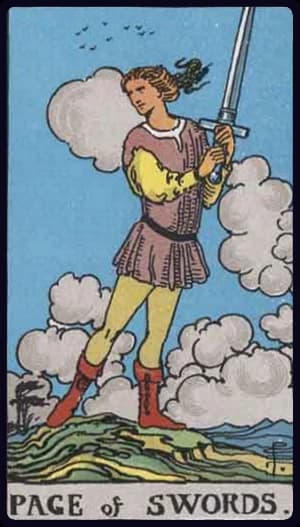
Page of Swords
swords · 11
Keywords: sharp curiosity, questions, quick study — reversed: scattered thought, sharp tongue, half-read.
Page of Swords in the Past position
Upright
The questions you asked before you were qualified to ask them are why you are here.
In the past position, the Page of Swords points at a stretch when you were the least experienced person in the room and asked anyway. You learned a subject from zero — a job, a language, a field somebody else had spent a decade inside — and you did it by being willing to sound uninformed out loud, which is the only method that has ever worked quickly.
Court cards describe a posture rather than a person, and the page is the posture of the student. Eleventh in its suit, it sits just after the ten, where a cycle has already closed and the sensible move would be mastery rather than apprenticeship. You took apprenticeship instead. The skill you now use professionally was assembled in that unglamorous stretch of not knowing.
What tends to get lost afterwards is that the speed was yours. People who learn fast usually describe themselves as having been thrown in, as though the water did the swimming. The record says otherwise: someone in your past kept asking the next question after the first answer was already good enough to stop at, and that habit did not expire.
Reversed
Somewhere behind you, asking questions became expensive, and you quietly adjusted.
Behind you sits a period when curiosity cost something. You asked in a room where asking read as incompetence, or you said the accurate thing at the wrong volume and watched it land as an attack. The Page of Swords reversed in this position records the moment the instrument got put down rather than sharpened, and it was a reasonable decision at the time.
The second shape this takes is the half-read one. You worked from summaries, headlines, the first two paragraphs of things, and for a long time that was enough — until a conversation where it was not, and the gap opened in front of people whose opinion mattered to you. The memory usually gets filed as embarrassment when what it actually describes is missing pages.
Either version explains a current reluctance better than it explains the original event. One produces a person who has stopped asking in public and researches privately at three in the morning. The other produces a person who over-prepares for conversations that carry no stakes at all. Working out which of the two you have already been carrying is worth more than relitigating what happened.
Page of Swords in the Present position
Upright
You are in a learning phase right now, and the discomfort is the phase working correctly.
The figure on this card stands on broken, uneven ground with the sword raised in both hands — a two-handed grip, which is what people use when the blade is heavier than their forearm. That is an honest picture of where you currently are. You are handling something you can lift but not yet swing, and the effort is far more visible to you than to anyone watching.
The Page of Swords in the present describes active intake: you are reading, asking, testing, checking what you were told against what you can observe directly. Wind moves through the clouds behind the figure and the birds are unsettled, which is the traditional signal for conditions that will not hold still long enough to be studied in comfort. You are studying regardless.
The practical instruction for today is to keep the questions narrow. Sharp curiosity dilutes into general interest very easily, and general interest produces nothing you can retrieve later. One precise question a week, asked of someone who genuinely knows, moves you further now than another month of ambient reading, and it puts you on record as someone learning rather than lurking.
Reversed
Right now the blade is out but the aim is loose, and something is landing harder than intended.
Twenty things have your attention today and none of them have all of it. Open tabs, half-finished threads, three books abandoned at the thirty-page mark. The Page of Swords reversed describes this state exactly: appetite intact, direction gone. None of it is a failure of intelligence, which is what makes it hard to catch, because every individual thing you picked up was worth picking up.
The other face of this reversal is tonal. Precision without warmth is currently reading as attack, especially in writing, where the tone you intended does not travel with the words. You are being accurate and someone is hearing contempt, and both of those can be true at the same time. The repair is not to be less exact; it is to say what the accuracy is for instead of trusting that to be obvious.
Then there is the half-read problem, which is the most common form of all. You have the summary and are arguing as though you have the source. It holds until someone who read the whole thing is in the room, and the real cost is not being wrong on that point — it is the quiet reassessment of everything else you have said with confidence. The cheapest correction available now is naming which parts you actually checked.
Page of Swords in the Future position
Upright
Ahead is a question that reopens something you had already filed as settled.
What arrives ahead under the Page of Swords is rarely a verdict; it is information. A message, a document, an offhand remark from someone with no stake in the matter, and the effect is that something you had closed becomes open again. Pages have always been messengers in this tradition, and the message this one carries takes the form of a question rather than an answer.
The second thing this position tends to indicate is a beginner's role you will be offered and be tempted to decline. Something coming will ask you to be the newest person in a subject at a point in life where that feels like the wrong direction. This card sits eleventh in its suit for exactly that reason: starting again after a completed cycle is an ordinary move, not a demotion.
The useful preparation is deciding in advance how you want to be corrected, because correction is the form the next stretch of learning will take. People who learn quickly are not the ones who mind it less. They are the ones who settled ahead of time that the information is worth the moment of looking uninformed, and that is a far cheaper decision to make now than in the room itself.
Reversed
A conversation coming up will reward being right much less than you expect it to.
The reversed Page of Swords in the future position points at an exchange where accuracy and effectiveness come apart. You will have the better argument, the more careful reading, the actual numbers, and winning the point will cost you the thing the point was meant to serve. A sword cuts in whatever direction it is held, and this one is angled at a person rather than at a problem.
A second pattern worth watching for ahead is the project built on a half-read premise. Something starts fast on partial information, momentum arrives well before verification does, and the correction gets more expensive every week it is deferred. This is not an argument against moving quickly. It is an argument for writing down, on day one, the single assumption that would sink the whole thing if it turned out to be false.
The scattered version is the third possibility: several new interests opening at once, each of them genuinely interesting, which is what makes the next few months easy to spend and difficult to account for. If that is the shape yours takes, choose the one you would still pursue if nobody ever heard about it, and let the rest stay unfinished on purpose rather than by drift.
What if this card comes to you?
Pull three cards for your own question — past, present and future. Free, no account needed.