


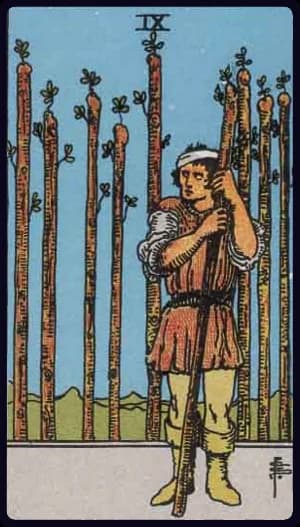
Nine of Wands
wands · 9
Keywords: resilience, one more push, guarded stance — reversed: depletion, paranoia, quitting near the end.
Nine of Wands in the Past position
Upright
The wariness you carry was earned round by round, and it came from surviving, not from fear.
In the past position, the Nine of Wands points at a sequence of demands you met one after another — a job that kept asking for more, a family situation nobody else was going to handle, a stretch of months where stopping was not on offer. You met them. The record of that is not a story you tell at dinner; it is a set of instincts you now have.
The card shows eight staves already planted behind the figure, and that is the accurate image for what sits behind you: each one was set in place at a cost, and none of them was free. Before now, most of that effort was invisible to other people, which is why the standard question — why are you so guarded — misses the arithmetic entirely.
What this position offers is a correction of the record. Being hard to reach, slow to trust, quick to check the exits — these were reasonable adaptations to conditions that actually existed. The useful move is to date them. Knowing which year taught you a particular reflex tells you whether the conditions that justified it are still in the room.
Reversed
Something behind you drained more than it returned, and you have been filing the exhaustion as discipline.
The Nine of Wands reversed in the past usually marks a stretch you never recovered from. The demand ended — the project shipped, the relationship closed, the crisis passed — and nobody announced that the emergency was over, so you never stood down. Depletion that goes unnamed gets recorded as personality rather than as a debt someone still owes you.
There is a second version worth checking against your own history. You may have stopped one round from the end. Something got close to finished and you walked away, and the reasons at the time were good ones — the cost, the people, the odds — but the unfinished thing did not evaporate. It became the private evidence you now cite against yourself.
Either shape leaves the same residue: a guard posted against a war that already ended. The Nine of Wands reversed in this position is less about what happened to you and more about what stayed switched on afterwards. Dating the moment the threat actually lifted is more practical than relitigating whether it was survivable, since that verdict is already in.
Nine of Wands in the Present position
Upright
You are tired in a way that is not a verdict on your capacity, and there is still ground under you.
Right now the Nine of Wands describes a position held well past the point of comfort. Something has gone on long enough that you are running on procedure rather than enthusiasm, and it is still working. That distinction matters: this is not a portrait of collapse, it is a portrait of somebody operating at reduced supply and delivering anyway.
Look at what the figure is doing with the ninth staff. He is leaning on it, not swinging it. Today the sharper question is which of your defences are load-bearing and which are merely habitual — where the guarded stance is doing real work, and where it is weight you carry from room to room out of routine rather than necessity.
The practical read here is about budgeting rather than willpower. One more push is a real instruction, but it assumes you know which push. Currently the most common failure is spreading whatever is left evenly across every front, instead of spending it on the single place where holding the line still changes what happens.
Reversed
The fence is doing its job so well that nothing useful is getting through it either.
Inverted in the present, the Nine of Wands shows a defence that has outgrown its threat. Currently you are reading neutral things as tests — a short message, a delayed reply, a question asked in a meeting — and the reading is fast, confident and mostly wrong. Suspicion of that quality is a symptom of depletion rather than a form of insight.
The second shape is quitting within sight of the end. There is something at eighty per cent that you are quietly preparing to abandon, and the case for abandoning it is currently sounding extremely reasonable. Exhaustion is an unreliable narrator about value: it does not tell you the thing is worthless, it tells you that you cannot feel the difference anymore.
The test that separates the two is concrete. List who has actually opposed you this month, by name. If the list is short and the sense of siege is large, the problem is the supply line rather than any enemy. Rest is not a reward you earn at the end of this; right now it is the only intervention that changes what you are able to see.
Nine of Wands in the Future position
Upright
What is coming asks for less than the stretch behind you, though it will not feel that way at the start.
In the future position, the Nine of Wands describes a last round rather than a fresh campaign. Something ahead will ask you to hold a position one more time, and the thing worth knowing in advance is that it is shorter than what you have already absorbed. Nine sits one step from the ten, at the far end of this suit's arithmetic.
The card makes no promise about the outcome you want. It says the capacity is present and already tested, which is a different and more durable claim than optimism. What you will be drawing on next is not some fresh reserve of enthusiasm but the specific competence you built during the stretch when nobody was watching you build it.
The preparation that helps is deciding now what finishing looks like, in one sentence, with a date attached. Resilience without a defined endpoint turns into endurance for its own sake, and endurance has no natural stopping point — which is how people push straight past a win they had already earned and never register crossing it.
Reversed
Ahead, the old guard gets carried into a room that never threatened you, and it costs you the room.
A reversed Nine of Wands in the future position tends to describe posture arriving ahead of evidence. You will walk into something new — a team, an arrangement, a beginning with no connection to the last one — with the armour still on, and the people there will meet the armour instead of you. Nothing dramatic follows; the room simply stays colder than it needed to be.
The other form is a slow leak. Coming months put a series of small demands on a reserve you have not refilled, none of them large enough on its own to justify a refusal, and the total shows up as a flatness you cannot trace back to any single cause. This is why the forward reading of this card is about supply rather than courage.
Both versions are catchable early if you watch for the right signal. Set two markers now: the next time you assume somebody is against you, check whether they have actually done anything, and the next time you agree to a request, check what it draws from a reserve you have not counted. Neither check requires you to become trusting or tireless.
What if this card comes to you?
Pull three cards for your own question — past, present and future. Free, no account needed.