


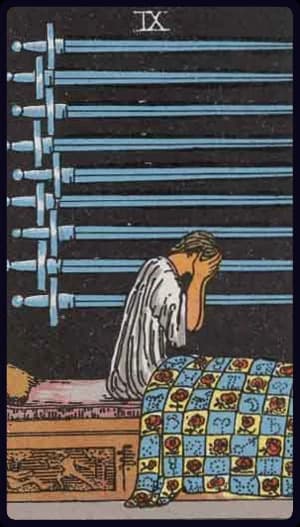
Nine of Swords
swords · 9
Keywords: night worry, rumination, worst-case rehearsal — reversed: daylight, sharing the fear, spiralling further.
Nine of Swords in the Past position
Upright
A stretch of sleepless nights behind you taught you to expect the worst before it ever arrived.
In the past position, the Nine of Swords marks a period already behind you when the nights did the work the days refused to do — a stretch of weeks or months spent assembling every version of a situation that could go wrong. Something real was usually happening then, and the rehearsal was a reasonable attempt to be ready for it.
Notice what the image actually shows: the nine swords hang on the wall behind the figure, mounted and horizontal, never once touching the body in the bed. That detail is the whole traditional reading of the card. The injury was anticipated rather than delivered, and most of what you survived in that period you survived in advance, at night, alone, in your own head.
The useful thing to take from this position is an honest accounting rather than a verdict. Some of that vigilance genuinely protected you; it caught a problem early, or it kept you from being blindsided by someone who did in fact behave badly. The rest was tax, paid nightly on events that never came, and separating the two is the work this card leaves behind it.
Reversed
Either you said the fear out loud once and it shrank, or you never did, and both still shape you.
The Nine of Swords reversed in the past splits along a single question: did you ever tell anyone? One version is the night you finally described the entire spiral to someone at two in the morning and watched it lose half its mass in the retelling. Daylight, in this card's vocabulary, is rarely an actual sunrise — it is usually another person's ordinary voice saying an ordinary sentence back to you.
The other version is a fear that stayed sealed. The Nine of Swords reversed can describe rumination that was never exposed to anyone else's judgement and therefore never had to survive contact with reality. Kept private for long enough, a worst-case scenario stops behaving like a scenario at all and quietly becomes a background assumption about how things generally go for you.
Which version you lived through explains a good deal about how you handle bad news before it has been confirmed. If disclosure worked once, you may have failed to file it as evidence and treated the relief as coincidence. If it never happened, the private spiral is probably still running on material from a situation that resolved years ago without notifying you.
Nine of Swords in the Present position
Upright
Something you are currently rehearsing at night is a very different size in the morning.
In the present position, the Nine of Swords describes something measurable rather than mystical: the matter occupying you right now is not the same size at three in the morning as it is at ten. Nothing about the situation changes overnight. What changes is which faculties are online, and at that hour the ones that estimate probability are the first to shut down.
The figure in the card sits upright in the dark with both hands covering the face, and that gesture is the one part of the image worth taking literally — the eyes are covered by choice, not by circumstance. Nine is the second-to-last number in the suit of swords, the point where thought has already done everything it can do and continues anyway, well past where more thinking yields more information.
The honest test today is whether this worry has produced a single new fact in the last week. If you can name one, the thinking is doing real work and deserves the hours. If you cannot — if you are cycling through the same three scenarios in the same order, arriving at the same place — then what you are calling preparation is a rehearsal, and rehearsals do not change opening night.
Reversed
Right now the spiral is either thinning in open air or being fed by the checking you call research.
The Nine of Swords inverted in the present points at two motions that both involve the fear moving somewhere. In the first, it is coming out — you have started saying parts of it aloud to someone, and each part loses a little weight on the trip from your head to your mouth. It is unglamorous and it works, and the Nine of Swords reversed is frequently describing nothing more complicated than that.
The second motion is the spiral gathering speed, and it almost always wears the costume of diligence. Re-reading a message thread, checking a number, searching a symptom, running the conversation once more with a slightly worse ending — each act is individually defensible and the aggregate is fuel. Today's version of this card asks what you actually do in the twenty minutes after the fear shows up.
The distinction is easy to make and uncomfortable to apply. Track whether the fear is smaller or larger after you engage with it. Speaking it tends to shrink it, because no second person can sustain your exact intensity for very long. Checking tends to grow it, because each check briefly relieves the pressure and teaches you that checking is what relief requires.
Nine of Swords in the Future position
Upright
Ahead is a waiting period, and this card is about the interval rather than the verdict at the end.
In the future position, the Nine of Swords describes an interval rather than an event — a stretch of days or weeks ahead in which something stays pending and undecided. A result, a reply, a scan, a decision sitting on somebody else's desk. The card says nothing about how it lands. It says the waiting is the hard part, and that most of the difficulty will arrive after dark.
What makes this position genuinely useful is that it gives you the shape of the thing in advance. The news comes eventually, and by then the nights are already spent. Traditional readings place this card second-to-last in the suit for a reason: every sword is still hanging on the wall, which is to say the harm in the coming stretch is anticipated harm, and anticipated harm is the only kind anyone can be talked out of.
The preparation worth making now is logistical rather than emotional. Decide who you will message at two in the morning and what the hour gets spent on instead of research. People skip this because planning for it feels like conceding that the bad nights are coming, but a plan made in daylight is the difference between a long night ahead and a short one.
Reversed
What resolves next may not release you, because the worry has learned to travel without its object.
A reversed Nine of Swords in the future position most often describes relief that fails to land. The thing you have been dreading gets settled — the reply arrives, the result is unremarkable, the meeting is fine — and the release you expected simply does not come. Within a week the same nightly machinery is running on a fresh subject, which is the clearest evidence available that the subject was never the mechanism.
The other shape is a spiral that stops being nocturnal and starts organising daytime choices. Declining invitations quietly, keeping the circle small, arranging a life with fewer surfaces on which the feared thing could occur. Nothing about it looks like distress from outside, nobody remarks on it, and that is exactly why this version can run for years without being named.
Both shapes respond to the same preparation, and it is not further insight into the fear itself. What moves the pattern forward is exposure and company: telling one person the unedited version rather than the presentable summary, and testing one avoided thing against reality instead of against imagination. Progress here is counted in what you stop declining, not in how calm you manage to feel.
What if this card comes to you?
Pull three cards for your own question — past, present and future. Free, no account needed.