


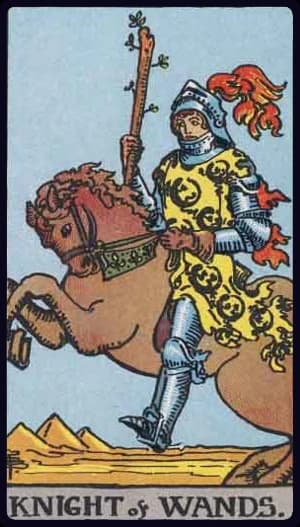
Knight of Wands
wands · 12
Keywords: charge, bold action, charisma — reversed: recklessness, burnout, half-finished dash.
Knight of Wands in the Past position
Upright
Speed built something behind you, and the people you swept along are still part of the result.
In the past position, the Knight of Wands marks a stretch when you moved before the plan was finished and everyone else caught up afterwards. A project got started, a move happened, a relationship began at a pace that alarmed the people who cared about you. It worked well enough that you are here, reading about it.
The card is the twelfth of Wands and shows a rider on a horse already mid-rear, the animal committed before the reins have said anything. Salamanders run across his tunic, the old emblem for the creature that survives its own fire. That image describes the version of you that acted first and explained later, and explaining later is not the same as failing to think.
What tends to get lost is the charisma half of it. Bold action rarely travels alone — someone lent you a room, a contract, a benefit of the doubt, because the conviction was legible on your face. If you now file that period under luck or youthful nonsense, you have written off a working method along with its rough edges.
Reversed
A dash you abandoned partway through is still setting the terms for how much you let yourself want.
Behind you, a reversed Knight of Wands usually points at an unfinished sprint rather than a disaster. You started at full speed, the first stretch went well, and then your attention moved elsewhere before the thing was done. Nobody filed a complaint; the project simply stopped, and over time the stopping became evidence about your character.
There is a second version worth separating out. Sometimes the heat was real and the run was complete, and what followed was depletion — months of living on conviction, then a flat stretch afterwards that felt like a permanent change of personality. Burnout of that kind gets misread as having outgrown ambition, when it was the bill for a pace nobody had funded.
Either shape leaves the same residue: a quiet contract with yourself never to be that person again. It is worth checking whether the contract is protecting you or only keeping the volume low. What went wrong in the old charge was the aim and the follow-through, not the wanting, and those are separable in a way that most people never actually test.
Knight of Wands in the Present position
Upright
Right now there is heat available to you, and heat has a short shelf life.
Something currently holds your attention out of all proportion — a plan, a person, a piece of unfinished work — and you are noticeably more awake around it than around the rest of your week. In the present position the Knight of Wands reads that as loaded energy rather than energy you still have to manufacture.
The horse in the image is not being urged forward; it is being held. That is the live scene of this card today. The animal is ready, and the only open question is direction, because bold action without a target is just noise with good posture. The Knight of Wands rewards aim considerably more than it rewards nerve.
The practical use of this is narrow. Name what a charge would actually consist of this month — one call, one submission, one conversation held at full volume — and notice that momentum of this kind does not keep. Fire is the element of the suit for a reason: what you have on hand right now is combustion rather than storage, and it burns down whether or not you point it somewhere.
Reversed
You are currently going fast, and the speed is doing a job that has nothing to do with arriving.
Motion has come apart from purpose, and the Knight of Wands reversed is precise about that today. Things are getting done — messages sent at midnight, three new files opened this month, a decision announced loudly in a meeting — and none of it converges on anything. The activity itself has quietly become the point.
The other face of this card right now is an empty tank being driven anyway. Recklessness and burnout look like opposites and share a cause: neither one stops to ask what the fuel is for. If you are currently pushing through a flatness that rest would fix, the charge you are performing is a costume of the one you used to have.
A workable test is to describe what would be true in six weeks if this pace continued unchanged. If the honest answer is a pile of half-finished dashes, the problem is selection rather than commitment — too many objects for one quantity of fire. Choosing two things to actually land is less exciting than opening a fourth, which is exactly why it is the harder move to make.
Knight of Wands in the Future position
Upright
Something ahead will move faster than your usual deliberating speed, and that is the price of it.
The opening that arrives next tends to have a short fuse. In the future position, the Knight of Wands describes a situation that rewards the first credible move rather than the best-prepared one — an invitation, a posting, a piece of work someone wants a name attached to by Friday. That window will not stay open for the length of your normal decision cycle.
Traditionally this card also carries departure. The desert and the pyramids behind the rider mark ground already crossed, and what is coming may involve literal distance — a move, a trip, a change of scene — or its social equivalent, where you become the person visibly doing the thing while other people watch and comment. Both versions ask for conviction in public.
The preparation that helps here is unglamorous. Decide in advance what you would say yes to, and what the first forty-eight hours of a charge would actually look like on your calendar, because the Knight of Wands ahead of you does not hand out a thinking week. Boldness is much easier to produce when it was budgeted earlier and only the timing came as a surprise.
Reversed
The next thing you say yes to at speed is the one worth reading twice before the pen moves.
What comes forward under a reversed Knight of Wands is usually attractive rather than obviously wrong. An offer, a person, or an idea arrives at high velocity and with real charm, and the pressure to match its pace is where the cost sits. Somebody else's speed inside their own plan is not the same thing as momentum inside yours.
The second shape is your own dash going flat somewhere ahead. Something begins well, the first stretch is easy, and the point where it stops being novel arrives well before the result does. This is the half-finished pattern the reversed card is named for, and it becomes something you can plan around as soon as you admit that it repeats.
Neither version has to play out. The useful move now is to set one condition in advance — a check the thing has to pass, a date by which it must have produced something real — so the next charge gets measured against a standard you wrote while calm. Most of what this card costs is lost to a decision made before the excitement starts.
What if this card comes to you?
Pull three cards for your own question — past, present and future. Free, no account needed.