


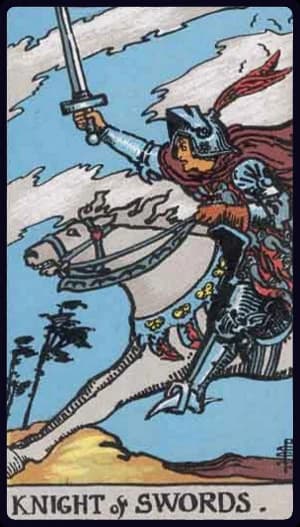
Knight of Swords
swords · 12
Keywords: decisive rush, straight line, argued point — reversed: blunt force, no brakes, argument for its own sake.
Knight of Swords in the Past position
Upright
Somewhere behind you, you decided fast and said the thing plainly, and that is why you are here.
In the past position, the Knight of Swords points to a moment when you stopped weighing and moved — a message sent before you could soften it, a question asked in a room where everyone had quietly agreed not to raise it. It was faster than your normal process, and the record suggests that the speed was the correct instrument for that particular problem.
The image is a charge already in progress: horse at full gallop, sword up, wind bending the trees behind the rider. Nothing in the picture shows the arrival, because the card is about commitment to a line rather than about the destination. What you did before was pick a direction and remove your own escape routes, which is a rarer skill than it sounds.
What matters in this position is how you have filed the memory since. People tend to remember a decisive past move as out of character — a fluke of adrenaline, or a day they happened to be braver than usual. The Knight of Swords disagrees. Whoever cut through it then is the same person reading this, and that capacity did not expire when the situation closed.
Reversed
A point you pressed too hard once already is why you now ration every blunt sentence you own.
Reversed in the past, the Knight of Swords describes a charge that went through something rather than around it. You were right, probably — that is usually the difficult part — and being right was not enough to make the delivery survivable. What broke afterwards was rarely the argument itself; it was whatever relationship had to absorb the speed.
There is a second shape here, quieter than the first. Sometimes the charge behind you was not aimed at anything real: a dispute taken up because it was available, a position defended long after you stopped believing it, because stepping back would have registered as losing. The energy was genuine and the target was borrowed, and that combination leaves very little to show for the effort.
Either version explains a habit you are carrying now. This card inverted in the past tends to produce someone who has overcorrected — pre-apologising, padding every clear statement, treating their own directness as a known hazard. The original event is closed and unavailable for editing. The tax you have been paying on it ever since is neither, and that is the part worth examining.
Knight of Swords in the Present position
Upright
There is one thing you are currently right about, and the only open question is delivery speed.
Right now the Knight of Swords is describing a conclusion you have already reached and have not yet said out loud. The analysis is finished. You have run the counterarguments, found them thin, and are currently occupying the odd interval between knowing and announcing — an interval people habitually mistake for continued thinking.
Twelfth in the suit and the most kinetic figure in its court, this rider carries no shield and keeps nothing in reserve. That is the trade on offer today: you get the force of a straight line, and you give up the option of looking flexible while you travel it. Momentum of this kind is genuinely useful, and it has never once been free.
The practical work here is aim rather than nerve. A charge is only as good as the thing it is pointed at, so the task in front of you now is naming the single sentence that actually needs saying — not five of them, one — and deciding who hears it first. Precision at speed is what this card rewards; volume at speed it has no use for at all.
Reversed
The argument you are in today has quietly detached from the outcome you started it for.
The Knight of Swords inverted in the present describes momentum that has outlived its reason. Somewhere inside the current dispute the object changed: you began wanting a decision, a change, an acknowledgement, and at some point you began wanting to win. The Knight of Swords reversed is what that switch looks like from outside — motion with no brakes and no destination left in it.
The second form is subtler and far more common among competent people. You are moving quickly today, across tasks and conversations and plans, and the speed is doing a job unrelated to any of them: it is keeping you a few hours ahead of a feeling. Nothing on the schedule is dishonest, but the pace is, and pace is remarkably hard to audit from inside it.
A serviceable test takes about a minute. Write down what would have to happen for the current fight to be over — a specific concession, a specific decision — then notice whether you would actually accept it if offered. If the answer disappoints you, the fight has become the point. The Knight of Swords reversed is not asking for silence; it is asking what you are aiming at now that the target has moved.
Knight of Swords in the Future position
Upright
Something ahead gets decided by whoever says the plain version of it first.
Ahead of you is a moment that closes faster than most, and the Knight of Swords is describing its tempo rather than its outcome. A conversation, a negotiation, a room where a decision is quietly forming — the window in which your input changes anything will be shorter than the window in which it is technically welcome.
What is coming rewards one clear line over a complete case. The rider carries a single sword, not an argument in seven parts, and that is the usable instruction: a position you can state in one sentence travels, while a position that requires setup gets postponed and then settled without you in the room.
Preparation for this is unglamorous and best done before any pressure arrives. Decide in advance what your sentence is and what you are willing to be wrong about in front of people, because in the moment the reflex will be to qualify. Going forward, the Knight of Swords tends to favour whoever turned up already knowing which hill they came for.
Reversed
A charge is coming with no landing plan, and its real cost shows up after the win.
Coming toward you is speed without a stopping condition. Something will move fast and pull you along with it — a confrontation you did not schedule, a decision made during a heated hour — and the difficulty will not be losing. The Knight of Swords reversed more often describes winning in a way that removes the thing the win was for.
The other version worth watching for is an argument that arrives already wearing a respectable disguise. It will look like principle and operate as pressure release: a stand taken over something small because something large is unresolved and, for now, unspeakable. Displacement of this kind is persuasive precisely because the smaller point is usually valid on its own terms.
The preparation is a brake installed early, since brakes cannot be fitted mid-gallop. Pick one condition — a sentence you will not say, a room you will step out of, a number of minutes after which you stop — and treat it as fixed rather than negotiable. The Knight of Swords loses almost none of its force by being given a stopping point; it simply stops arriving somewhere you never wanted to be.
What if this card comes to you?
Pull three cards for your own question — past, present and future. Free, no account needed.