


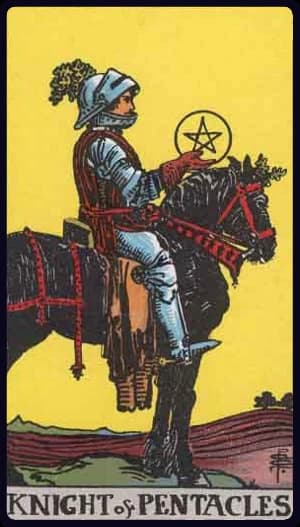
Knight of Pentacles
pentacles · 12
Keywords: steady progress, reliability, slow and sure — reversed: stagnation, stubborn pace, risk-averse to a fault.
Knight of Pentacles in the Past position
Upright
What holds you up now was assembled slowly, by a version of you nobody was watching.
In the past position, the Knight of Pentacles points to work that was already finished before anyone noticed it happening — a qualification earned over years of evenings, a debt cleared in unremarkable increments, a craft drilled long past the point where it stayed interesting. None of it made a good story, which is usually why it goes missing from the account you give of yourself.
He is the one knight in the deck whose horse has stopped walking, and the field behind him is already plowed into even rows. That detail carries the reading: the ground you are standing on was prepared by repetition rather than by any single decisive moment you could point to and name in a sentence.
The correction worth making here is arithmetic rather than emotional. If you file that stretch under nothing much happened, you also file away the method that produced it, and the method is the transferable part. Someone who once ground through four unglamorous years without an audience can do it again, deliberately, on something chosen instead of inherited.
Reversed
Behind you is a long stretch where staying put got mistaken for building something.
The Knight of Pentacles reversed in the past describes a period that had every appearance of diligence and almost none of the accumulation. The hours were real. The routine was real. But it maintained a situation rather than constructing one, and the difference only became visible later, when you went looking for what had been built and found the same room.
There is a second version, equally common. An opening appeared, the price of taking it was disruption to a system that already worked, and you declined on grounds that were genuinely sensible at the time. The Knight of Pentacles reversed is the figure who stays in the saddle without moving; his horse was standing still to begin with, and inverted, that pause hardens into a posture.
What matters is which of the two you are still carrying. One version leaves you overvaluing effort and undervaluing direction; the other leaves you flinching at any plan that costs you your footing. The event itself is finished and unavailable for revision, but the habit it installed is very much present and choosing on your behalf.
Knight of Pentacles in the Present position
Upright
Something you are doing right now is boring, unfinished, and working exactly as intended.
The Knight of Pentacles in the present position usually lands on a project currently in its least interesting phase — past the excitement of starting, nowhere near the satisfaction of finishing, held together entirely by showing up. That middle stretch has no reward built into it, which is why most things are abandoned there rather than at the genuinely hard parts.
In the image he holds a single pentacle in both hands and studies it instead of the horizon. Only one. The card's argument is that attention split across many possibilities produces motion without deposit, so today's useful discipline is subtraction: what is the one thing you are actually carrying, and what have you been pretending to carry beside it?
Speed is the wrong instrument right now. Ask instead whether this week's version of the work would still be recognisable if you repeated it fifty times, because that repetition is what the outcome is physically made of. Steady is not a consolation prize in this position — it is the mechanism, and it mostly fails when interrupted to check whether it is working.
Reversed
The pace you are defending as patience may simply be a way of not deciding.
Inverted in the present, the Knight of Pentacles describes a stall dressed as method. The work continues, the calendar stays full, and yet nothing currently in motion has a date attached to it. Systems get refined, preparation deepens, standards climb — and the thing itself does not ship, because shipping is the only part that could visibly go badly.
The other face of this is stubbornness about tempo. You have a way of doing things that served you well once and now costs more than it returns, and every suggestion to change it reads as an attack on your standards. The heavy horse under this knight is bred for hauling, not for turning, and a refusal to turn looks identical to reliability right until it doesn't.
A blunt test: name what would have to be true for you to move faster, then check whether that condition is achievable or infinitely deferrable. If it can never quite be met, caution has stopped being a judgement and become a setting. Nothing here calls for recklessness — only for the current slowness to be a choice you are making today rather than one you inherited.
Knight of Pentacles in the Future position
Upright
Ahead is a return on effort that arrives too gradually to feel like an event.
In the future position, the Knight of Pentacles rarely describes a breakthrough. What is coming is accumulation crossing a threshold — the point where quietly built competence starts producing offers, trust, or income without you campaigning for any of it. It will not feel like a moment, and that flatness is regularly mistaken for nothing happening at all.
Numbered twelve, this figure sits at the end of the court's slow ranks, the one who has stopped rehearsing and simply does the work. Read forward, that is the role becoming available to you next: not the person with the idea, but the person the thing gets handed to because they finish. That reputation is unglamorous and extremely difficult to take away from you.
The practical preparation is to define what completion looks like before the long middle wears down your judgement of it. Set the standard now, in writing, while the project still interests you. The version of you doing the actual hours later on will be grateful to be following instructions rather than renegotiating with motivation every single morning.
Reversed
What comes next may ask for a change of pace you would rather negotiate around.
A reversed Knight of Pentacles in the future position points at a plateau whose edge is already faintly visible. The work keeps producing, but at a diminishing rate, and the temptation ahead will be to answer that by doing the same thing harder rather than differently. Effort is the most comfortable variable to increase, which is exactly why it gets chosen first.
The second shape is an opportunity that arrives with a shorter fuse than your process allows for. Something will want a decision before you have finished examining it, and the reflex that has protected you for years — check everything, commit last — is going to argue convincingly for delay. Whether that argument holds will depend on the specific case, not on the reflex.
Neither shape is fixed, and the card is not describing loss. It describes a season in which the steadiness that built things begins holding them in place instead. Decide in advance what evidence would tell the two apart: a number that has flattened, a skill that has stopped growing, a routine you would defend fiercely but could not justify to someone else.
What if this card comes to you?
Pull three cards for your own question — past, present and future. Free, no account needed.