


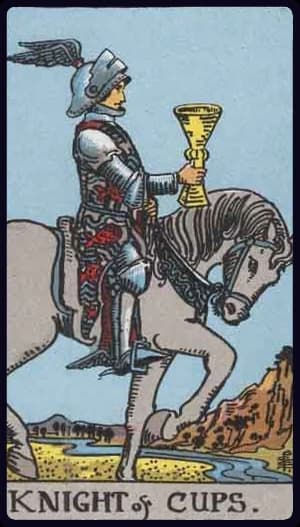
Knight of Cups
cups · 12
Keywords: romantic gesture, following feeling, sincerity — reversed: over-promising, moody retreat, escapism.
Knight of Cups in the Past position
Upright
Something you offered sincerely, without calculating the return, is why this part of your life exists.
In the past position, the Knight of Cups marks a moment when you led with feeling and it happened to be the correct instrument. A message sent, a preference admitted, an offer extended before you had any assurance it would be received. Whatever you have now — a relationship, a body of work, a friendship — traces back through that gesture more directly than through any plan you made.
He is the only knight in the deck who does not charge. The horse moves at a walk, the cup is held level so nothing spills, and the winged helmet marks him as a carrier of messages rather than a combatant. Twelfth in the suit of Cups, he is what feeling looks like once it has decided to travel somewhere and be seen doing it.
The useful correction here is about how you filed the memory. People who led with sincerity and got a good result often relabel it afterwards as luck, or as youth, or as something they would not risk again. The Knight of Cups behind you says the risk was legible and you took it deliberately, and that the capacity did not expire with the occasion.
Reversed
A promise you made in a warm moment and could not carry is still editing how carefully you speak.
The Knight of Cups reversed behind you usually describes an offer that was real when it was made and unavailable by the time it came due. Not a lie — the feeling was genuine in the moment it was spoken, which is exactly what makes it hard to account for later. Somebody adjusted their plans around it, and that somebody may well have been you.
The other common form is the retreat. Something asked more of you emotionally than you had budgeted for, and rather than say so, you went quiet and let the distance do the explaining. The Knight of Cups reversed is the horse turned back toward the water, the cup lowered, the message undelivered because delivering it meant staying present for the answer.
What either version leaves behind is a policy. People who over-promised once tend to under-state everything afterwards; people who withdrew once tend to withdraw pre-emptively. The original event is finished and not open to revision. The policy it installed is still running in the background, and that is the part actually available to look at.
Knight of Cups in the Present position
Upright
There is a gesture you keep composing and not sending, and its sincerity is not what is in question.
Right now this card tends to describe an unsent thing. A message drafted several times, a question you have rehearsed in the car, an offer you have costed out emotionally and not yet made. You are not stuck on whether you mean it. You are stuck on the gap between meaning it privately and putting it somewhere another person has to respond to it.
The Knight of Cups rides toward a stream cutting through dry ground, and the image is precise about direction: he goes where the water is, at a pace that lets him be seen coming. Nothing about the card is stealthy. The cup is extended rather than guarded, and currently that extension is the whole content of the reading — the offer becomes real the moment it leaves your hands.
The honest question today is whether you can tolerate a warm gesture landing in a room that stays cool for a while. Sincerity does not oblige anyone to match it, and that asymmetry is the real cost people are dodging when they call it bad timing. The Knight of Cups makes no claim about reception. It says only that the offer is worth making undiluted.
Reversed
The version you are living in your head is currently more detailed than the one actually on offer.
Escapism is the word most readings reach for here, and it is nearly right but far too broad. The Knight of Cups reversed in the present is more specific than that: an imagined relationship, project or conversation is receiving more of your attention than the real one, and it wins because it never disappoints and never has to be negotiated with.
The second reading is the moody retreat. Something went slightly wrong — a delayed reply, a tone you did not like — and instead of naming it you have withdrawn a measured amount and are waiting to see whether it gets noticed. The withdrawal does communicate, which is the point, but it communicates something unspecified and leaves the other person guessing at the charge.
Then there is over-promising, which happens now in real time: agreeing to things while the feeling is high, then finding the calendar disagrees. All three share one mechanism, which is feeling being used to avoid a concrete exchange. The test is to say out loud, in one sentence, what you are actually asking for, and notice how much of the mood survives the sentence.
Knight of Cups in the Future position
Upright
An approach is coming that arrives at walking pace, easy to miss if you are expecting something louder.
What opens ahead with this card is an approach rather than an event. Someone makes a move toward you, or you make one toward them, and it comes carried rather than negotiated — an invitation, a piece of work offered because somebody liked what you did, a reconciliation initiated by the party who did not strictly have to initiate it.
The Knight of Cups travels slowly on purpose, and that is the part worth preparing for. This will not announce itself as a turning point. It will look like a small overture that could be answered with politeness, and politeness is the standard way these get declined without anybody having to formally decline anything at all.
The practical preparation is deciding in advance what a sincere approach is worth to you, because in the moment sincerity reads as either embarrassing or insufficient depending on your mood that week. The Knight of Cups asks one narrow question next: when something is offered plainly, can you receive it plainly, or do you need it complicated first?
Reversed
Ahead is an offer that sounds larger than what either side can realistically carry.
Two shapes are worth watching for in what comes next. The first is inflation: something gets proposed with great warmth and vague terms — a plan, a partnership, a statement about how things are going to be from here — and the warmth is genuine while the terms stay unspecified, because specifying them would be the same as testing them.
The second is the disappearance. A connection or a project that has been moving will go quiet without a stated reason, and the silence gets filled by whichever explanation you find most familiar. The Knight of Cups reversed does not specify who withdraws. Sometimes the person who goes quiet ahead of the difficult conversation is you.
Neither shape is a catastrophe; both are ordinary and both are workable with a single habit. Convert warmth into specifics early — a date, an amount, a next step — not to audit anyone's affection, but because the Knight of Cups reversed describes feeling that never quite got translated into action, and the translation is the only part in your hands.
What if this card comes to you?
Pull three cards for your own question — past, present and future. Free, no account needed.