


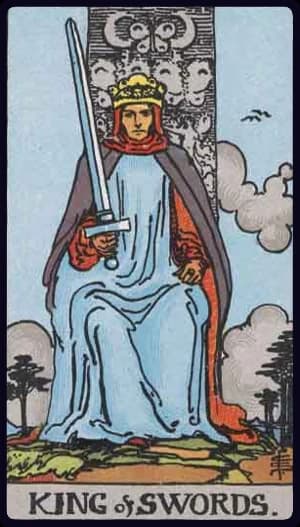
King of Swords
swords · 14
Keywords: judgement, principle, structured mind — reversed: hair-splitting, cold ruling, logic as shield.
King of Swords in the Past position
Upright
A ruling you made on principle rather than preference is why people bring you the hard questions.
In the past position, the King of Swords marks a decision you settled by standard rather than by mood — a line you drew, a rule you applied to yourself first, a call that cost you something and that you made anyway. It probably did not feel like wisdom at the time. It felt like the only sentence you could say without lying.
The card is the fourteenth and last of its suit, which is what a suit of blades becomes when it stops swinging: a seated figure, sword upright, butterflies carved into the stone behind him. That image is not a fighter. It is someone who has already argued enough to know what an argument is for, and you bought that knowledge before you noticed you were paying for it.
The useful read here is about where your authority actually comes from. If you assume people consult you because you are quick, you will keep sharpening the wrong tool. They consult you because you once held a position that was inconvenient to hold, and that record — not your reasoning speed — is what you have been living on ever since.
Reversed
Somewhere behind you, being right was worth more than being understood, and you learned the exchange rate.
Reversed behind you, the King of Swords usually describes a room where correctness was the local currency — a parent who won on technicalities, a teacher who graded your reasoning and ignored your face, a first job where whoever had the tightest argument set the terms. You adapted, because adapting was the only available move.
That adaptation carried a cost that took years to appear on the invoice. You became difficult to argue with and easy to misread. This card inverted points at a mind trained to prove rather than to be known, and a prover is hard to comfort, because comfort arrives in a format the training had already filed away as imprecise.
The other version of this reversal is that you were the one issuing the verdicts, and one of them landed harder than intended on someone who never got a hearing. Nothing in the past is available for appeal, which is exactly why the narrower question is the productive one: what standard were you enforcing, and whose was it before it became yours?
King of Swords in the Present position
Upright
Right now you are the one holding the criterion, and the room is waiting for you to say it out loud.
Currently the King of Swords sits where the deciding voice is, which means you hold more information than you have been admitting to holding. There is a situation you could name accurately in one sentence and have not, usually because the sentence is unkind in the short term and true in every term after that.
The figure faces forward, the only king in the deck who looks straight at the reader, sword tilted slightly as though it has just been raised or is about to be lowered. Today that ambiguity is the whole point. Judgement in this card is not the pleasure of a verdict; it is the willingness to be the person whose name goes on it.
What makes the King of Swords workable right now is that it asks for a stated principle instead of a stated feeling. Write out the rule you are actually operating by — the one that would still apply if the people involved were strangers. If the rule survives that swap, you are judging. If it does not, you are negotiating, and it would be cleaner to call it that.
Reversed
The precision you are deploying today is quietly doing a second job you have not admitted to.
The King of Swords inverted in the present is not about being wrong. It is about being unanswerably right inside a conversation that was never really about the facts. You are winning on definitions, correcting the timeline, asking what someone means by a particular word — and each of those moves is legitimate, which is what makes the pattern so hard to catch.
The King of Swords reversed describes logic worn as armour. Swords are the deck's suit of thought, and thought is the only weapon that can be swung while the face stays calm. Right now the cost is probably not that you lose the argument. It is that people stop bringing you the version of things that has feeling in it, and you get briefed instead of confided in.
A blunt test for this week: in your last disagreement, could you state the other person's position in a form they would agree with, without appending a correction? If not, you are currently sorting rather than listening. The hair-splitting is doing real work — it keeps the conversation on ground where you cannot be hurt.
King of Swords in the Future position
Upright
Ahead is a call for judgement rather than sympathy, and telling those two apart will be the whole test.
What is coming, in this position, is a request for a ruling. Someone will bring you a situation — or your own life will hand you one — that cannot be resolved by being pleasant about it, and the King of Swords lands here when the next useful move is a decision made on stated grounds rather than a mood managed carefully.
The card carries no promise that the ruling will be popular. Fourteen closes out a suit's arc, and what it offers is not victory but jurisdiction: the right to decide, along with the obligation to have a reason. Expect the reason to be requested, possibly by someone who will dislike it, and to have to give it without raising your voice.
The practical preparation is to settle your principles before the case arrives, because principles chosen inside a specific situation tend to be shaped by whoever is standing in front of you. Write down now what you would rule if the person asking were a stranger, then keep that sentence. Forward from here, the King of Swords is easier to carry when the standard predates the pressure.
Reversed
A coming decision will be technically flawless and expensive in a currency you are not counting.
The reversed King of Swords ahead of you tends to describe a verdict that is correct and costly at the same time. The contract is watertight, the message is unanswerable, the boundary is entirely defensible — and something that was warm before will not be warm afterwards. Both halves of that are real; only one of them shows up in the record.
The other shape this takes is sitting on the receiving end. Someone in the coming stretch may hand you a ruling with no hearing attached — a policy, a decision already made, a closed tone that treats your case as processed. The temptation will be to answer in the same register, which is how this card reproduces itself across a whole relationship.
Neither version is dramatic, which is why it is easy to walk into. The preparation that helps is a question you can ask yourself in the moment ahead when you are plainly right: what am I buying with this, and would I still pay that price if I were not currently annoyed? The King of Swords reversed is not asking you to drop the standard. It is asking what the standard is for.
What if this card comes to you?
Pull three cards for your own question — past, present and future. Free, no account needed.