


Four of Wands
wands · 4
Keywords: celebration, homecoming, milestone — reversed: postponed party, unstable base, hollow ritual.
Four of Wands in the Past position
Upright
Something behind you was finished properly, and the ground you stand on was poured then.
In the past position, the Four of Wands points to a threshold you actually crossed — a move, a graduation, a contract signed, a relationship made public. What matters is not the event itself but that it was marked. You stopped long enough to say out loud that one stage had ended and another had started, and that pause did structural work you have probably stopped giving yourself credit for.
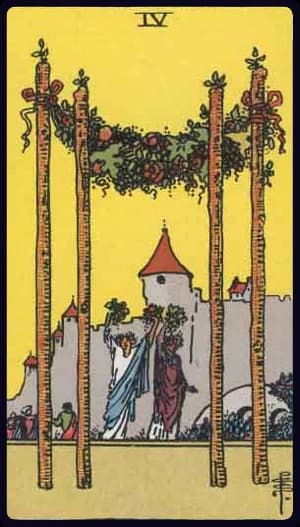
The four staves in the image are not walls. They are corner posts holding up a canopy, the lightest structure that still counts as shelter, and the number four supplies the logic — four corners, four legs, the minimum arrangement that stands without leaning on anything else. Whatever you assembled back then was built at exactly that scale: enough to gather under, not enough to hide inside.
Behind the two figures raising their bouquets there is a walled town that was already standing before the garland went up, and that is the part most readings skip past. The celebration takes place outside the gate, in front of a place that existed first. Read that way, what carried you here is not the party but the years of ordinary maintenance that made a homecoming possible at all.
Reversed
A completion in your history was either skipped without ceremony or staged for the wrong audience.
The Four of Wands inverted behind you describes a finish that never got its moment. One version is the unmarked one: you closed a chapter on an ordinary Tuesday, answered email that afternoon, and let the ending pass without a witness. Nothing was lost that anyone could point to afterwards, which is exactly why it kept quietly costing you something.
The other version is the ceremony that happened and belonged to somebody else. The party occurred, the correct sentences were said, and you spent the evening managing other people's feelings about your own milestone. A ritual performed for an audience you did not choose tends to record an event without closing it, so some part of you is still standing at that threshold.
There is also the question of the base. Four upright staves only hold a canopy if the ground underneath is firm, and a good deal of past celebration gets built on soft ground — the title accepted before the role existed, the shared address agreed on to end an argument. Whichever of these is yours, the thing worth identifying is not the old event but the habit it installed around marking anything at all.
Four of Wands in the Present position
Upright
You have finished something real and are currently treating it as a step toward the next thing.
Right now the Four of Wands is pointing at something you have already completed and have not yet allowed to count. The pattern is easy to spot from outside: the milestone gets described as a stepping stone, congratulations get deflected into talk of what remains, and the finish line quietly relocates to wherever you are not currently standing.
This is the most domestic card in the fire suit, and that is deliberate rather than accidental. Fire here is not ambition or conquest; it is the light in a house where people have arrived. The garland strung between the staves is made from the season's own harvest, which means the decoration is literally the yield — the celebration is not separate from the work, it is the work made visible.
The practical function of marking a finish is that it tells your own nervous system the file is closed, and skipping it leaves everything technically still open. Today the useful move is smaller than it sounds: name the thing as done, in one plain sentence, to one person who was there for the difficult middle of it. The Four of Wands rewards being received, not being applauded.
Reversed
The gathering currently on your calendar is doing a job that nobody has named out loud.
Inverted in the present, the Four of Wands often describes a celebration asked to carry weight it cannot carry. Two situations produce the same discomfort. In the first, the date keeps moving — the housewarming waits for the last shelf, the announcement waits for one more confirmation — and readiness has become a receding condition rather than a state you could reach.
In the second, the event happens on schedule and lands flat. Everyone says the correct things, the photographs are fine, and you feel almost nothing at all. That flatness is information rather than ingratitude: a ritual only closes a stage if the stage has genuinely closed, and marking something still unresolved produces a hollow sound you can hear from the inside.
The test that separates them is uncomfortable and quick. Ask whether the arrangement underneath would hold today with no ceremony scheduled at all — no party, no announcement, no shared photograph. If it holds, the Four of Wands reversed is only telling you to stop postponing the marking. If it does not, the event is being used as scaffolding, and scaffolding never becomes a foundation.
Four of Wands in the Future position
Upright
An arrival is coming that gets witnessed, which is a different thing from an achievement.
The Four of Wands in the future position marks a point ahead where something you have been assembling privately becomes visible to other people. It is rarely dramatic in the way people expect. A lease, a launch, a return to a room you left under worse conditions — the card describes the moment a long stretch of effort finally acquires a date and a doorway.
What makes this position specific is who is in the room. The card is not about a prize; it is about being received, and the difference shows up afterwards. Recognition from strangers fades within the week, while an arrival witnessed by people who saw the unglamorous middle of it changes what you believe you are capable of starting next.
So the preparation worth doing in advance is unusually concrete. Decide who you would want present, and whether you will let the moment be marked at all rather than folding it straight into the following project. People who habitually skip the marking find each new beginning heavier than it needs to be, because nothing behind them was ever formally closed.
Reversed
The date ahead may keep sliding, or arrive exactly on time and land on nothing.
Going forward, the Four of Wands reversed most often shows up as a date that moves in two-week increments. Something is scheduled — a move, an announcement, a gathering, a formal start — and it keeps being adjusted for reasons that are individually reasonable. The pattern is only visible if you count the adjustments rather than assessing each one on its own merits.
The second shape is the opposite and harder to see coming. The event arrives on schedule while the base under it is still unset: the promotion into a role with no budget, the shared home agreed on with one large question unanswered, the public commitment made to settle a private doubt. The canopy goes up on time and the corner posts keep sinking.
Neither shape is a verdict, and both respond to the same preparation. Write down, before any of it is imminent, what the foundation would actually need in order to be sound — the specific conversation, the number, the signature — and keep that list separate from how ready you happen to feel. Nervousness and instability look identical from inside, and only one of them is a reason to wait.
What if this card comes to you?
Pull three cards for your own question — past, present and future. Free, no account needed.