


Four of Swords
swords · 4
Keywords: rest, deliberate pause, recovery — reversed: restlessness, skipped recovery, forced return.
Four of Swords in the Past position
Upright
A stretch of quiet you once took, and probably apologised for, is what made everything after it survivable.
Behind you sits a period that produced nothing anyone could point to — a convalescence, a leave, a season of doing close to the minimum. The Four of Swords places that interval at the root of what followed, because the capacity you have been spending since was rebuilt inside it rather than earned anywhere louder.
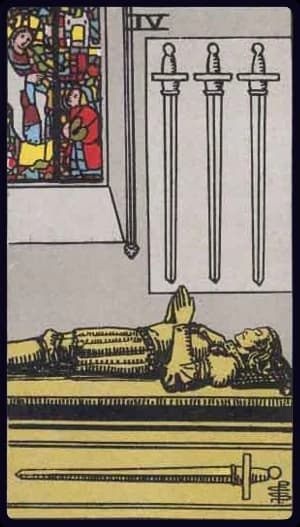
The image on the card is a knight laid out in stone inside a chapel, three swords fixed to the wall above him and a fourth resting along the length of the tomb. The detail that matters is that the swords are still present. Nothing was surrendered during that pause; the weapons were set down within reach, which is exactly what separates rest from retreat.
The practical question is how you have filed the memory. If you call that stretch lost time, you have already agreed that stopping costs you something rather than returns something, and that accounting will decide whether you ever permit yourself the same repair twice. The evidence of your own recovery argues against the way you have been describing it.
Reversed
Somewhere behind you a recovery got cut short, and your stamina has been running on borrowed terms ever since.
What the Four of Swords reversed points at in the past is a stop that never completed. Something ended — an illness, a separation, a piece of work that emptied you — and you were back in circulation long before the repair was done, either because circumstances pushed or because lying still felt worse than being tired.
There is a second version, harder to see because it looks compliant. You did clear the calendar, and then spent the whole of it monitoring: replaying conversations, drafting the next move, checking whether anything had gone wrong in your absence. The body was in the chapel and the attention was still out on the field, so the interval passed without doing what an interval exists to do.
Both shapes leave the same residue, and it surfaces now as a suspicion of stillness. Quiet reads as exposure, slowing down produces guilt instead of relief, and productivity becomes the only setting in which you feel legitimate. The original episode is closed and cannot be re-run; the reflex it installed is operating today, and the reflex is the part with a handle on it.
Four of Swords in the Present position
Upright
The pause in front of you is not a reward for finishing — it is the mechanism that makes finishing possible.
Right now there is a gap in your schedule that you keep quietly filling in. The Four of Swords turns up in the present position when the space has already been carved out and is being colonised by errands, favours, and small defensible tasks that are considerably easier to perform than sitting still is.
Notice what the figure on the tomb is actually doing: hands folded, eyes closed, light arriving through a stained-glass window from one side. This has never been a card about death. It depicts a suspension that is chosen and bounded, which is a different act from collapse — collapse takes the same time without your consent and charges a far worse rate for it.
The honest question today is what you believe will happen if you stop. For most people the answer turns out not to be a consequence but an image: being seen as someone who needed to stop. Naming that plainly costs less than the two months of thinning output you would otherwise spend disproving it, and the thinning has usually started already.
Reversed
Your body has stopped moving and nothing else has, which is why the rest currently is not working.
The stillness you have at the moment is not doing its job. Technically you are off — a weekend, a leave, a quiet run of days — while the vigilance keeps running at full power, checking, anticipating, rehearsing conversations that have not happened. The Four of Swords inverted describes rest held as a calendar entry rather than entered as a state.
The other shape is a return demanded before you were finished. Someone needs a decision, a date moves, a situation reopens, and you agree to it in a single sentence while telling yourself you were basically fine anyway. That sentence takes four seconds to say and tends to be repaid over the following several weeks in units of concentration you cannot spare.
A usable test right now: name what you would do with an unobserved afternoon that nobody would ever hear about. If the answer arrives instantly and you are still not doing it, the missing thing is permission rather than time. If no answer arrives at all, the restlessness has been running long enough to erase the destination, and that is worth knowing before you book anything.
Four of Swords in the Future position
Upright
A window for genuine repair is coming, and it will look inconveniently timed, because that is how they arrive.
Ahead of you is an interval rather than an event. A project closes, a season ends, a demand lifts, and a gap opens that can either be spent recovering or refilled inside a week. The Four of Swords makes no claim about what happens in the gap; it says the gap is coming and that it is real rather than wished for.
What makes this worth preparing for is that the choice will not announce itself. Nobody schedules recovery on your behalf, and every offer that arrives to occupy the space will be reasonable on its own terms. The knight in the chapel is not waiting on permission from anyone else in the picture — the pause in this card is entered, never granted.
So set the shape of it in advance, while nothing is pressing: how many days, protected against what, and what specifically is not permitted to follow you into them. Deciding early matters because in the moment the calculation gets run by whichever part of you is most depleted, and exhaustion negotiates badly on its own behalf.
Reversed
The rest waiting ahead gets shortened, skipped, or spent on someone else's emergency unless you fence it early.
The recovery further ahead is the kind that gets postponed on excellent grounds. The reasons will arrive on schedule — a launch, a family obligation, a stretch of work only you can cover — and each will hold up perfectly well in isolation, while the Four of Swords reversed points at the pattern those reasons keep out of view for another season.
The second form is a return staged too early. You come back at sixty per cent, perform at sixty per cent, then read the result as information about your ability rather than about your timing, and go hunting for more effort to fix something only time repairs. That misreading usually costs more than the original depletion did, and it compounds quietly.
The preparation available is unglamorous and effective. Put the recovery in the calendar before the demand for it exists, and give it a boundary you can say out loud to another person. Commitments made to someone else survive contact with a crowded week; intentions held privately are the first thing traded away, and they are traded without comment.
What if this card comes to you?
Pull three cards for your own question — past, present and future. Free, no account needed.