


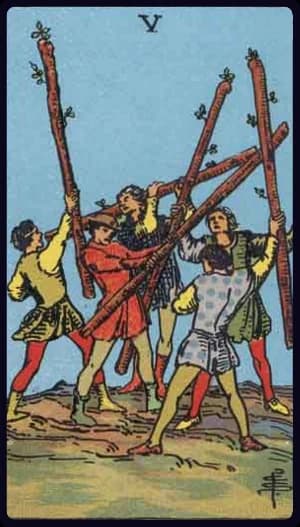
Five of Wands
wands · 5
Keywords: friction, competition, scrappy energy — reversed: avoided conflict, wasted rivalry, truce.
Five of Wands in the Past position
Upright
You were sharpened in a crowded room, and the people you competed against did most of the teaching.
In the past position, the Five of Wands points to a stretch of your life spent in company you had to contend with — a class, a team, a family, a market where several people wanted the same limited thing. It was noisy and rarely comfortable, and it raised your standard faster than any private effort would have.
The card shows five figures swinging staves in no particular formation, and the detail worth keeping is that nobody in the image is injured. What happened back then was friction rather than damage: rehearsal at full intensity, with real stakes attached to a contest that nobody entirely won and nobody entirely lost, which is precisely why it kept going long enough to teach you anything.
What this position asks is whether you have kept the skills and dropped the story. People who came up in scrappy conditions often describe those years as something they merely survived, which quietly hides how much of their present competence was assembled there — the timing, the nerve, the ability to hold a position while somebody argues against it. The friction was the curriculum, not the interruption.
Reversed
A fight you stepped out of, or one you fought with the wrong person, still shapes how you enter rooms.
Reversed in the past, the Five of Wands describes contested ground you left before the contest resolved. Perhaps you conceded a position to keep a relationship intact, accepted a truce that settled nothing, or stopped showing up to a competition you had a genuine claim on. The dispute closed on paper and stayed open in you.
There is a second and more common version: rivalry aimed at someone who was never actually in your way. Energy that belonged in the work went into measuring yourself against a colleague, a sibling, a person on a screen. Already at the time it felt urgent, and in retrospect the scoreboard was borrowed from somebody else.
Either shape leaves the same residue. You may over-prepare for disagreements that are not coming, or go quiet the moment a room turns competitive, on the grounds that it went badly before. Naming which of the two happened is more useful than relitigating it, because the old argument is closed and the reflex is not.
Five of Wands in the Present position
Upright
The conflict you are in right now has no villain in it, which is why winning will not close it.
In the present position, the Five of Wands describes an argument currently running on unsorted terms. Several people are pushing at once — inside a project, a household, a group chat — and each of them is defending something reasonable. What is missing is not goodwill but structure: nobody has said out loud what is actually being decided.
Five is the number where the suit's earlier stability breaks apart into motion, and Fire is the element carrying it. That is the mechanism today: energy is abundant and unaimed. The staves cross in the image because the figures are swinging in a shared space, not because any one of them has identified a target.
The practical move is to stop treating the friction as a relationship problem and start treating it as an information problem. Write down what each person in the dispute is trying to protect. Most of the heat in a Five of Wands situation comes from people optimising for different things while using the same vocabulary, and once that list exists the argument usually shrinks to a size you can hold.
Reversed
Everyone is being agreeable and nothing is being decided, and the pressure is going somewhere else.
This card inverted in the present usually means the disagreement has gone underground. The meeting ends pleasantly, the message thread cools, and the substance is untouched. A truce is being maintained at the cost of the decision it was meant to produce, and the unspent charge of the Five of Wands reappears as fatigue, sarcasm, or a slow withdrawal of effort.
A second reading is available now, and it is the more expensive one: rivalry that produces nothing. You are currently tracking somebody else's progress closely enough to feel it in your chest, although the two of you are not competing for anything a third party would recognise as the same prize.
Both versions waste the same resource. Friction is only useful where the work is, against someone who genuinely wants what you want. The reversed Five of Wands asks a narrow question today: is there one specific conversation you are keeping polite, and what would it cost to make it accurate instead? The answer is usually smaller than the avoidance implies.
Five of Wands in the Future position
Upright
Ahead is a contested field where several capable people want the same thing you have been wanting.
In the future position, the Five of Wands points to an arena rather than an outcome. Something coming will place you among competitors — a hiring round, a pitch, a shortlist, a room where your work sits beside work of comparable quality. The card says the field will be crowded; it does not hand out the result.
Knowing the format in advance is what makes this useful. You will be assessed comparatively rather than absolutely, so preparation that only proves you are competent moves very little. The question the situation actually puts to you is what you carry that the other four staves in the picture do not.
It is also worth deciding beforehand how you want to behave once the pressure arrives. Contests of this shape reward people who stay legible under scrutiny — who can disagree without making it personal and lose a round without leaving the field. That temperament gets settled in advance, because in the moment the room's tempo takes over and rehearsed instincts are the ones that show up.
Reversed
A dispute ahead gets smoothed over before it is settled, and it returns wearing different clothes.
Reversed in the future, the Five of Wands most often describes a conflict that ends without being resolved. Someone will propose peace early — a compromise, a change of subject, a reshuffle that separates the parties — and the relief will be genuine. The underlying disagreement travels with everyone involved and surfaces again in the next arrangement.
A second form is withdrawal dressed as maturity. An approaching contest will look beneath you, or badly timed, or not worth the energy, and each reason will be individually true. What the card watches for is the pattern rather than the instance: contests keep appearing and keep being declined on grounds that sound like perspective.
The preparation that helps here is unglamorous. Decide now what a real resolution would look like — a named decision, a written owner, a date — so that any truce can be measured against something instead of accepted because the room got tired. Choosing which fights to enter is a legitimate strategy going forward; the Five of Wands reversed only asks that the choice be made deliberately rather than by flinch.
What if this card comes to you?
Pull three cards for your own question — past, present and future. Free, no account needed.