


Five of Swords
swords · 5
Keywords: hollow victory, cost of winning, conflict — reversed: making amends, walking off the field, lingering resentment.
Five of Swords in the Past position
Upright
You won an argument some time ago and have been quietly paying the invoice ever since.
In the past position, the Five of Swords marks a conflict you came out of holding the field. You were right, or right enough, and you pressed it until the other side stopped talking. What the card records is not the verdict but the receipt — the friendship that thinned afterwards, the team that stopped bringing you things, the relative who is perfectly polite now and nothing more than that.
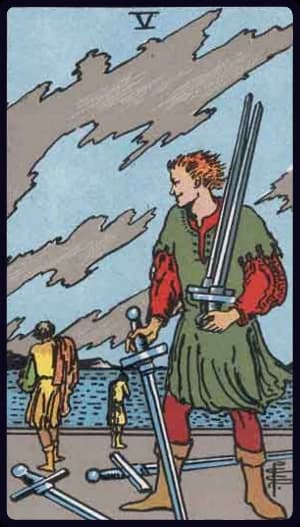
The picture is unusually specific about aftermath. One figure gathers the fallen swords with an expression somewhere between satisfaction and doubt, while two others walk toward the water with their backs turned, and the sky behind them is still ragged from the weather that has just passed. Nobody in the scene is celebrating. The win already happened; what the image shows is the minute after it.
The practical read here is separating two things you have probably filed together: being correct and getting what you wanted. In the conflict behind you those came apart, and if you have never said that plainly to yourself, the episode is still shaping how you enter disagreements — either avoiding them entirely or arriving already braced to win. Naming the actual cost is what finally retires it.
Reversed
Something behind you ended without a settlement, and the resentment has been keeping the books.
The reversed Five of Swords in this position describes a conflict that stopped rather than closed. Perhaps you walked off the field mid-argument because continuing was pointless, or an apology was exchanged that handled the form of the thing without ever touching its substance. Either way the matter got filed as finished, when what actually happened was that it was paused.
Amends sits in this card's reversed vocabulary, and amends is usually the part that went missing before. What tends to appear in its place is a truce — a return to ordinary conversation about weather and logistics, with the real subject placed permanently out of bounds. That arrangement is workable for years, and it has one reliable tell: certain topics make the room go careful.
This matters because unsettled conflict does not stay in its original location. The lingering resentment from an old dispute usually resurfaces as a disproportionate reaction to something small and unrelated — a tone in an email, a decision made without you, a name left off a list. Tracing the size of the reaction back to the earlier event is more useful than relitigating it, since the earlier event is closed to revision and the reaction is not.
Five of Swords in the Present position
Upright
There is a fight running right now that you are winning on points and losing everywhere else.
What the Five of Swords marks in the present is an active conflict in which your position is genuinely strong. You have the facts, the record of who said what and when, and probably the better argument. The card does not dispute any of that. It asks a different question: what the win is going to cost, and whether you have priced it or simply assumed it comes free.
Fives across the deck describe instability — the point where a settled structure gets tested — and in the suit of swords that test happens in language. Right now the disagreement is likely being conducted in writing: messages, threads, documents where every sentence is retrievable and quotable later. That format rewards precision and punishes generosity, which is why disputes held there escalate so reliably.
A concrete test for today: describe the outcome you want without describing the other person being wrong. If the description survives that edit, keep going, because the disagreement is about something real. If it collapses into who is right, the Five of Swords is showing you a contest whose only prize is acknowledgement, and acknowledgement extracted under pressure is never worth what it costs to obtain.
Reversed
You have stopped arguing out loud without stopping the argument.
Inverted in the present, the Five of Swords usually shows up after the visible part is over. The conversation ended, everyone went back to work, and the dispute moved indoors where it now runs continuously — replies drafted in the shower, sharper versions of what you should have said arriving fully formed at two in the morning.
The other current form is an apology that is really a manoeuvre. You are considering saying something conciliatory, and underneath the wording sits a hope that conceding first will produce the admission you actually want. Amends offered as a trade rarely lands as amends; the other person can hear the invoice inside it, and the exchange leaves both of you further from settled than before.
Both versions run on the same engine, which is that the conflict never received an ending you agree with. The useful move now is unglamorous: decide what you are prepared to accept without the other side's cooperation. That is not forgiveness and it does not require them to participate — it is simply choosing to stop paying rent on a room you no longer live in.
Five of Swords in the Future position
Upright
Ahead is a contest you can win, and the thing worth deciding now is what winning is allowed to cost.
Something is coming that has a scoreboard attached — a negotiation, a dispute over credit or money, a disagreement where sides will form and people will notice which one you took. The Five of Swords in the future position says the outcome is genuinely available to you. It is notably quieter on the separate question of whether taking it is a good idea.
What makes this position useful is the advance notice. Conflicts are decided by terms set before they begin, and once the argument is underway nobody involved is calm enough to set them. Deciding now which relationships are not on the table, which concessions you would still make on the day, and what you would accept as a reasonable ending gives your later self something solid to hold.
The card's traditional gloss is hollow victory, but hollowness is not automatic. A win goes empty when the method costs more than the prize, and that ratio is something you can influence in advance rather than discover afterwards. If the matter genuinely counts, the Five of Swords is not asking you to concede it — it is asking you to know, before the first exchange, what you will not do in order to win it.
Reversed
Coming up is a chance to put something down — an apology, a grudge, or a field you have held far too long.
An opening arrives ahead that will not announce itself as one. Someone makes contact after a long gap, or circumstance puts you and a former opponent in the same room with a practical reason to be civil. The reversed Five of Swords marks these moments precisely because they are so easy to miss: nothing about them looks like resolution while it is happening.
One route forward is amends, and amends works far better when it is narrow. A specific sentence about a specific thing you did, offered without an accompanying account of what they did, is the version that tends to land. Broad apologies invite negotiation over the terms, and that negotiation reopens the original argument in slightly more polite language.
The other route is leaving the field, which is not the same as losing it. Some disputes ahead will be winnable and still not worth the season you would spend inside them, and declining one is a decision rather than a forfeit. What this card points at is the third option, the one nobody chooses deliberately: carrying resentment forward unexamined, where it quietly narrows the number of rooms you are willing to walk into.
What if this card comes to you?
Pull three cards for your own question — past, present and future. Free, no account needed.