


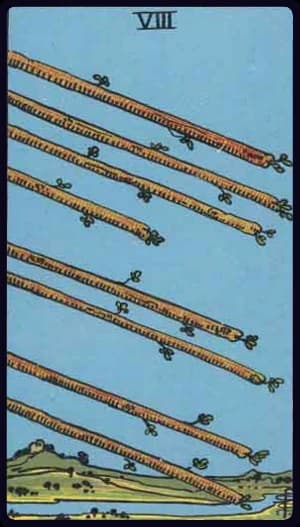
Eight of Wands
wands · 8
Keywords: acceleration, news arriving, clear runway — reversed: scattered rush, held-up message, premature launch.
Eight of Wands in the Past position
Upright
A stretch of speed behind you compressed years of ordinary progress into a few months.
In the past position, the Eight of Wands marks a stretch when everything landed at once — the reply you had stopped expecting, the introduction, the move, the yes that made three other things possible. Looking back, that period probably registers as weather rather than as a set of choices you made, which is how compressed time usually gets filed.
The card shows eight staves already in flight over open country, past the throwing and not yet landed, and it is the only card in its suit with no person in it. That absence is accurate to what happened. You were not driving the speed; you were the ground it crossed, and the whole event took its shape from how prepared that ground already was.
Which is the part worth reclaiming. The runway was clear before the acceleration arrived, and it was clear because of unglamorous things you had done beforehand — answering promptly, keeping a skill warm, staying reachable to people who eventually needed someone. Luck travels fast, but it only travels through openings that were made in advance.
Reversed
Something behind you moved too fast or never arrived, and you have been reading speed as risk since.
Reversed in the past, the Eight of Wands usually describes one of two histories. In the first, you released something before the runway was clear — sent the pitch, made the confession, announced the plan — and the momentum you were counting on scattered outward instead of travelling in one line toward a landing.
The second history is the opposite shape: a message that was held up. You waited on an answer that took months, or never came at all, and the silence did the work of a refusal without supplying any of the information a refusal gives you. There was nothing to correct and nobody to argue with, so the waiting quietly absorbed a whole season.
Both leave the same residue, which is why this card sits behind you rather than in front. You now read speed itself as a hazard. One version produces someone who prepares until the moment has passed; the other produces someone who follows up three times in a week. The original event is closed to revision. The reflex it installed is not.
Eight of Wands in the Present position
Upright
Whatever you set in motion is already in the air, and pushing harder now does nothing to it.
Right now the Eight of Wands describes a situation that has already left your hands. The application is in, the message is sent, the conversation happened, and the outcome is being worked out in a room you are not standing in. What makes this uncomfortable is less the uncertainty than having nothing useful to do with your hands.
The traditional image is eight staves in level flight, angled slightly down, close to the end of their arc. Nobody is throwing them and nobody is catching them. The translation for today is that added force changes nothing about what is already airborne, while a clear landing area changes a great deal — an open week, a fast reply, the second document ready before anyone asks for it.
The other half of this position is that news tends to arrive in clusters rather than singly. Several things resolve inside a short span, and the real hazard is agreeing to each one at the speed it appears. Set your terms now, while nothing is pending — the number you will accept, the timeline you can actually hold — because you will be answering these questions in real time rather than at leisure.
Reversed
You are moving at speed in eight directions at once, which currently reads to you as productivity.
Inverted in the present, the Eight of Wands marks the distance between velocity and direction. Eight things are moving. The days are full, messages go out, tabs stay open, and nothing has actually landed in weeks, because attention divided eight ways arrives everywhere slightly and nowhere completely.
There is a second shape this takes, and from inside it feels nothing like the first. One specific message is held up — an answer you are waiting on — and the waiting has moved into the foreground without announcing itself. Rereading what you sent, checking a phone that has not buzzed, drafting follow-ups you do not send: the wait is currently consuming the attention the rest of the work needs.
One sentence separates the two. Name the single thing that would count as having landed by the end of this month. If naming it takes more than a sentence, the issue is scatter rather than pace, and the remedy is subtraction. If the sentence is about somebody else's reply, the remedy is finding the piece of it that does not depend on them.
Eight of Wands in the Future position
Upright
Ahead is a stretch where things arrive faster than your usual pace of deciding.
The future position turns the Eight of Wands into a statement about tempo rather than content. Something ahead speeds up — an approval clears, a reply lands early, a delay you had already budgeted for simply does not happen — and events begin arriving closer together than your normal rhythm of deciding was built for.
In sequence this card follows the Seven of Wands, where a position was held under pressure. The eight is what the same situation looks like once the resistance stops pushing back. That is worth knowing in advance, because the coming acceleration tends to arrive in the area where you have been holding ground, and it rarely feels like a reward. It feels like a queue forming.
Preparation here is capacity, not enthusiasm. Clear a week where you can. Decide beforehand what you would agree to and on what terms, because speed does not make people choose badly by itself — it removes the interval in which they would normally notice they were about to.
Reversed
What comes next is likely to be delayed, or to leave your hands before it is finished.
A reversed Eight of Wands ahead points at the gap between when you expect something to move and when it actually moves. A reply takes three weeks instead of three days. An approval sits with someone who is simply not thinking about it, and the file that feels urgent to you is item nine on a list you will never be shown.
The delay is rarely personal, but it invites a personal reading, and that is the part worth preparing for. A held-up message starts to sound like an answer somewhere in the second week, and the story built during silence is usually far more decisive than anything the sender intended to communicate by being slow.
The other form this takes is a launch that goes out early — announcing, sending, committing before the parts line up — driven by the discomfort of waiting rather than by readiness. Both are handled by decisions made now rather than in the moment: a date on which you follow up, and a definition of ready that does not move when restlessness sets in.
What if this card comes to you?
Pull three cards for your own question — past, present and future. Free, no account needed.