


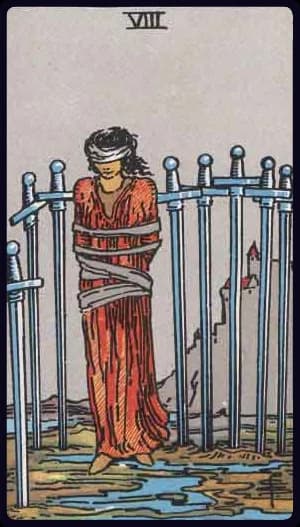
Eight of Swords
swords · 8
Keywords: self-made trap, narrow story, bound thinking — reversed: loosening, seeing the gap, stepping out.
Eight of Swords in the Past position
Upright
Somewhere behind you, a limit got described to you once and you filed it as a fact.
In the past position, the Eight of Swords points to a description that hardened into a boundary. Someone told you what you were not suited for — a teacher, a parent, a manager having a bad quarter — and the sentence was absorbed before you had the standing to test it. The swords in the image are planted in the ground by hand, one at a time, and this is the position where you can still see who was holding them.
What matters is that the description was probably accurate about a moment and then got applied to a person. You were slow at something once, or you handled a conversation badly at twenty-three, and the observation was reasonable at the time. It stopped being reasonable years ago, and nobody issued a correction, because corrections are not part of how this works.
Reading this card in the past is less about blame than about dating the evidence. The belief that has been quietly shaping your choices was formed with information that has since expired. Before deciding whether the constraint is real, it is worth asking when you last checked it, because most people find that the last audit was performed by someone who is no longer in their life.
Reversed
You already walked out of one of these, and you have never given yourself credit for it.
There is usually an exit in your history that you have never counted. A situation with a fixed shape — a role, a household, an arrangement everyone treated as permanent — ended, and you were on the other side of it without a clear story about how. The Eight of Swords reversed in the past position marks exactly this kind of undramatic escape, the sort that never enters your record as evidence of capability.
The alternative reading is that the bindings were cut for you. The company restructured, the lease ran out, the other person left first. Circumstance did the work, so the belief underneath was never actually tested; it survived the change fully intact and moved into the next enclosure alongside you, wearing the same shape and answering to different names.
The distinction is worth locating precisely, because it determines what you own now. If you got yourself out before, the method is already in your hands and merely unlabelled, and it can be repeated deliberately. If the situation dissolved around you instead, what you have is relief rather than a skill, and the skill is the thing still missing from the account.
Eight of Swords in the Present position
Upright
The sentence you keep repeating about your situation is currently doing the work of a wall.
Right now the Eight of Swords is describing a sentence rather than a circumstance. You have a line you say about your situation — I can't leave until, I'm not in a position to, it isn't the right time — and it has been stable long enough that nobody, including you, asks it for details any more. That line is doing more structural work than any actual obstacle in your week.
Look at the image accurately. The woman is bound with cloth, not chain. The swords stand in a partial arc with an obvious gap behind her, and her feet are free on soft ground. Nothing in the picture is locked. What holds her in place is the blindfold, which is not a restraint at all — it is a decision not to look, maintained continuously and at real cost.
The practical move today is small and specific: name the one piece of information you have been declining to gather. The salary range, the actual policy, what the other person would say if asked directly. Bound thinking runs on estimates, and it rarely survives contact with a number, which is precisely why the estimate has been allowed to stand this long.
Reversed
The gap is visible now, which turns out to be a different problem than not seeing it.
Something has loosened, and the discomfort has gone up rather than down. This is the ordinary shape of the Eight of Swords reversed in the present: the blindfold is off, the exit is in plain view, and the constraint you had been treating as external is now visibly a choice you keep making. Seeing the gap removes the excuse without supplying the nerve.
There is a second version worth checking today. Some people respond to the loosening by declaring themselves free while behaving exactly as before — the language updates, the calendar does not. Others over-correct and begin dismissing constraints that are genuinely load-bearing, treating a mortgage or a dependent as one more story to see through, which is how a real limit gets mislabelled as a mental one.
The useful test is whether anything in your actual schedule has changed in the past month. Not your understanding of the situation — your schedule. Insight without a scheduling consequence tends to become a more sophisticated way of staying put, and this card reversed is specifically about the stretch where knowing the way out has stopped being the hard part.
Eight of Swords in the Future position
Upright
Ahead is a moment where you say the constraint out loud and it fails to survive the sentence.
What opens in the future position with the Eight of Swords is unglamorous: a conversation, an application, a form, in which you are required to state the limitation plainly to someone who has no investment in it. Limits kept internally are maintained by rehearsal. Limits spoken to a neutral party get examined, and examination is what this card sets up next.
The card is numbered eight, deep in the suit of thought, which is where a position stops being a reaction and becomes a structure. Structures come apart the way they were built — one sword at a time, not in a single dramatic clearing. Expect the coming relief to be partial and procedural: one fact confirmed, one permission that turns out never to have been required.
The preparation that makes this worth having is deciding in advance what you will do with the first opening rather than what you will feel about it. Most narrow stories survive their own disproof because nothing was scheduled for the day after. Write down the specific next action now, while it is still hypothetical and therefore cheap to commit to.
Reversed
The bindings come off ahead of you, and the posture is what takes longer to leave.
Freedom arrives on somebody else's timetable in this version. A contract ends, a person moves on, a rule changes, and the enclosure that organised your last few years is simply gone. The Eight of Swords reversed in the future position is less about the release itself than about the weeks after it, when the restriction has lifted and you find yourself still standing where the swords used to be.
The second pattern to watch for is reconstruction. Given open ground, people who have spent a long time inside a narrow story tend to build a new one quickly, because a defined limit is easier to live with than an undefined field. The next enclosure will come with better reasons — obligations, responsibility, realism — and will function very much like the old one.
What makes this manageable is deciding now what you would actually do with a month of unrestricted choice, in concrete terms, before the choice exists. People who have not answered that question ahead of time tend to hand the answer to whoever asks first. The value of this reversal sits entirely in the interval between release and the next commitment, and that interval is short.
What if this card comes to you?
Pull three cards for your own question — past, present and future. Free, no account needed.