


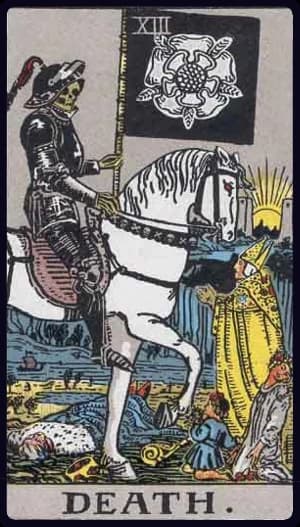
Death
Major Arcana · XIII
Keywords: ending, release, clean break — reversed: clinging, delayed ending, dragging it out.
Death in the Past position
Upright
Something in your past ended completely, and the effort of holding it stopped at the same moment.
In the past position, Death marks a conclusion that stayed concluded. A role, a relationship, a version of yourself — it finished, and it did not come back in a modified form. People often describe the aftermath of these endings as unexpectedly calm rather than devastating, because the energy spent maintaining the thing was released along with it.
The RWS image shows a rider passing figures of every rank, and the impartiality is the actual subject. Status did not exempt anyone. Read backwards, that is oddly consoling: the ending was not a judgement on you specifically, which is the story most people privately tell themselves about their own endings.
What this position asks is whether you have updated your account of yourself since. Endings that stay ended free up capacity, and it is common to keep operating at the old capacity out of habit — still budgeting attention for something that stopped needing it years ago.
Reversed
Something behind you was never properly finished, and it is still charging you for the ambiguity.
Reversed in the past position, Death describes an ending that was announced but never completed. The departure that took a year, the relationship that ended and continued, the project that was wound down in stages until nobody could say when it stopped. There is no date to point at, which is precisely why it does not process.
Endings without a boundary do not get grieved; they get absorbed. The cost is not the loss itself but the ongoing low-level accounting — a part of you still checking whether that thing is really over. People often mistake this for loyalty or for being bad at letting go, when it is closer to an unclosed ledger.
The practical read is that you may be owed a conclusion you never gave yourself. Death reversed behind you sometimes just needs a date assigned retroactively — a decision that it ended, made now, about something that ended then. That sounds like bookkeeping and functions like relief.
Death in the Present position
Upright
You have already stopped believing in something you have not yet stopped doing.
In the present position, Death is unusually specific. It describes the gap between an internal ending and an external one — the role still played, the messages still answered, the position still held, while the belief that animated it left some time ago.
This gap has a distinctive feel: exhaustion without a cause you can name. People commonly look for a medical or logistical explanation first, because the actual explanation — that they stopped meaning it — is harder to say out loud, and harder still to say to whoever else is involved. Death in the present tense is usually confirmation rather than news.
What the card does not say is what to do about it. It marks the point where the outside is about to catch up with a decision already made privately. The useful question is not whether to end it but how much longer you intend to pay for the delay, and what exactly that payment is currently coming out of.
Reversed
An ending is being managed rather than made, and the managing has become the situation.
Death reversed in the present describes active resistance to a conclusion that has already been reached internally. The signals are specific: the same conversation on a cycle, a decision deferred to a date that keeps moving, an arrangement kept alive by steadily increasing effort from one side while both parties describe it as fine.
Traditional readings here caution against reading postponement as care. Dragging out an ending is often framed as kindness, and sometimes is, but the ambiguity prevents everyone involved from moving — including the people the kindness was for. A clean cut is frequently the more generous option and almost always the harder one.
There is a less common inverse worth ruling out first: rushing an ending because finishing feels decisive, when the situation still has life in it. The distinguishing question is whether the finish would leave you relieved or bereft, answered quickly and without editing the answer into something more flattering.
Death in the Future position
Upright
Something ahead concludes cleanly, and what it frees will matter more than what it takes.
In the future position, Death reads as a schedule rather than a warning. Something resolves by ending rather than by improving, and it ends properly — no residue, no modified continuation. That completeness is the card's actual content and the reason it is not the ominous draw its reputation suggests.
The card tells you the mode of the ending, not its timing. Endings by conclusion behave differently from endings by collapse: they can be prepared for, and preparation mostly means deciding in advance what you want to carry across. People who do that describe the transition as clean; people who do not describe it as sudden even when it was visible for months.
The practical read is an inventory rather than a brace. If a current arrangement concluded, what would you want already learned, already said, already held somewhere other than inside it? Answering costs little and helps whether or not the timing lands as expected.
Reversed
Ahead is an ending that refuses to finish, or one you end early to feel decisive.
A reversed Death in the future position describes a conclusion that does not resolve. The likeliest shape is a long unwind: something ends on paper and continues in practice, with periodic renegotiation that resolves nothing. The cost is paid in attention over months rather than in a single difficult week.
The alternative shape is a premature cut — ending something because the ending itself feels like agency, particularly after a long period of feeling stuck. That reads as decisiveness from the inside and often produces the same situation again a year later with different names attached to it.
Both are more ambiguous than a clean conclusion, so the preparation is different. Decide now what evidence would tell you an ending has become permanent deferral: a repeated conversation, a date moved twice, a number that stops changing. Ambiguity is far easier to act on when the threshold was set before you were standing inside it.
What if this card comes to you?
Pull three cards for your own question — past, present and future. Free, no account needed.