


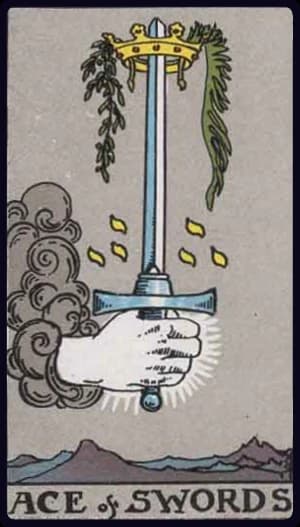
Ace of Swords
swords · 1
Keywords: clarity, cutting truth, naming it — reversed: confusion, harsh words, half-truth.
Ace of Swords in the Past position
Upright
Something got named accurately once, and the accuracy is what changed the shape of your life.
In the past position, the Ace of Swords points to a moment when something finally got said in plain words — a diagnosis, a resignation letter, a sentence in an argument that stopped the argument. Before that sentence, the situation had been managed. After it, the situation had a name, and names are what make things actionable rather than endurable.
The card shows a single blade held upright by a hand emerging from cloud, a crown resting at its tip. The image is not about violence; it is about the authority that clarity produces. Whoever described the problem first, back then, effectively set the terms everyone else has been working with ever since. If that person was you, that is a skill and not an accident of mood.
What this position asks is whether you kept the skill or filed it away as a one-time outburst. People often remember the accurate sentence as the moment they were harsh, because saying the true thing usually costs something socially. The Ace of Swords behind you suggests the cost was worth paying, and that the capacity to pay it again has been yours all along.
Reversed
A half-said truth behind you is still doing work, and it is doing the wrong kind of work.
Reversed in the past, the Ace of Swords describes a truth that came out at the wrong angle. Either it was delivered as a weapon — accurate, timed to wound, technically defensible — or it was delivered at seventy percent, edited into a version everyone could live with, which left the actual issue undisturbed underneath.
Both versions leave the same residue, which is distrust of your own sharpness. If a true thing you said once blew up a relationship, you learned that precision is dangerous. If a softened version kept the peace and solved nothing, you learned that precision is pointless. Neither lesson is accurate, but both were taught by real experience, and lessons taught that way hold.
The reason this belongs in the past position rather than anywhere else is that the original conversation is closed while the habit it produced is not. Look at how you open difficult subjects: over-qualified and pre-apologised, or unusually blunt to get it over with. That reflex was formed before any of this, by a blade that either cut too deep or never actually landed.
Ace of Swords in the Present position
Upright
There is a distinction you are refusing to make right now, and everything downstream depends on it.
The Ace of Swords in the present position usually means two things are being treated as one thing. A person and their behaviour. A decision and its timing. Being tired and being finished. The blur is not stupidity; it is what happens when separating them would oblige you to act today on the smaller, clearer piece.
This is the first card of its suit, and firsts in tarot are raw material rather than finished results. What is available now is not resolution but definition — the single clean cut that turns a heavy, vague situation into a specific question with a yes and a no attached to it. The olive branch and the palm on the crown are there because clarity is meant to end a conflict, not open one.
The practical move is small and unglamorous. Write the situation in one sentence with no hedging clauses, then notice which word you wanted to soften. That word is where the Ace of Swords is currently pointing. Most people already know the accurate sentence and are waiting for someone else to say it first, so that the social cost gets shared rather than carried alone.
Reversed
Right now the sharpest thing in the room is language, and it is being used to win rather than clarify.
The Ace of Swords inverted in the present covers a particular kind of noise: conversations that produce heat and no information. You are arguing well. The other person is arguing well. Nobody has stated what they actually want, because a stated want can be refused, and an unstated one can be defended indefinitely without ever being tested.
The other face of the reversed Ace of Swords today is a half-truth you are maintaining, probably a kind one. Something has been left ninety percent accurate because the final ten percent would force a decision. Holding that gap open costs attention continuously, which is why the whole situation feels tiring out of all proportion to its actual size.
The blade in the image is double-edged, and reversed it tends to get held by the wrong end. Precision aimed at a person becomes cruelty; precision aimed at a problem stays useful. The check available to you now is whether your last sharp sentence made the situation clearer to both of you, or only made your own position harder to challenge.
Ace of Swords in the Future position
Upright
Ahead is a piece of information that ends an ambiguity you have been living inside for a while.
What the Ace of Swords marks in the future position is a clarification rather than an event. A test result, a straight answer, a document, a sentence someone finally says — something arrives that removes the option of reading the situation two ways at once. The card makes no claim that the answer is the one you prefer. It says the ambiguity ends.
That matters more than it sounds, because ambiguity is expensive. A large share of what people call stress is simply the cost of holding two possible realities open at the same time. When the sword comes down and one of them closes, the first feeling is often loss, and the feeling directly after it is usually room to move again.
The preparation this card suggests is deciding in advance what you do with a clear answer, in both directions. Clarity coming toward you is only useful if it meets someone who intends to act on it; otherwise the Ace of Swords delivers a fact and the fact gets absorbed into the routine that already existed. Name the next step for each outcome while the question is still open.
Reversed
Coming toward you is an explanation that fits too neatly, and neatness is not the same as truth.
The reversed Ace of Swords ahead describes clarity that arrives distorted. Someone will offer an account that resolves the discomfort quickly — a reason for the silence, a version of what happened, a confident diagnosis of another person's motives. It will be partly true, which is exactly what makes it hard to argue with and easy to accept.
A second shape this takes is a conversation that travels further than intended. Something true and unkind gets said in the next stretch of time, and the accuracy of it will not reduce the damage, because statements delivered with force are remembered as the force. If a difficult exchange is already scheduled, the thing to prepare is the sentence, not the mood.
Neither version is dramatic, which is precisely why they slip past unexamined. What this card offers going forward is a test you can apply to any explanation that shows up: does it make the situation more specific, or only more comfortable? Real clarity tends to add detail and create work. A half-truth closes the file and leaves everything exactly where it was.
What if this card comes to you?
Pull three cards for your own question — past, present and future. Free, no account needed.